China Is Building Launch Pads Near Nuclear Missile Silos: What China's Massive Desert Military Expansion Means for the United States and Global Security

Satellite Images Reveal China's Expanding Nuclear Infrastructure Near Hami Missile Silo Field
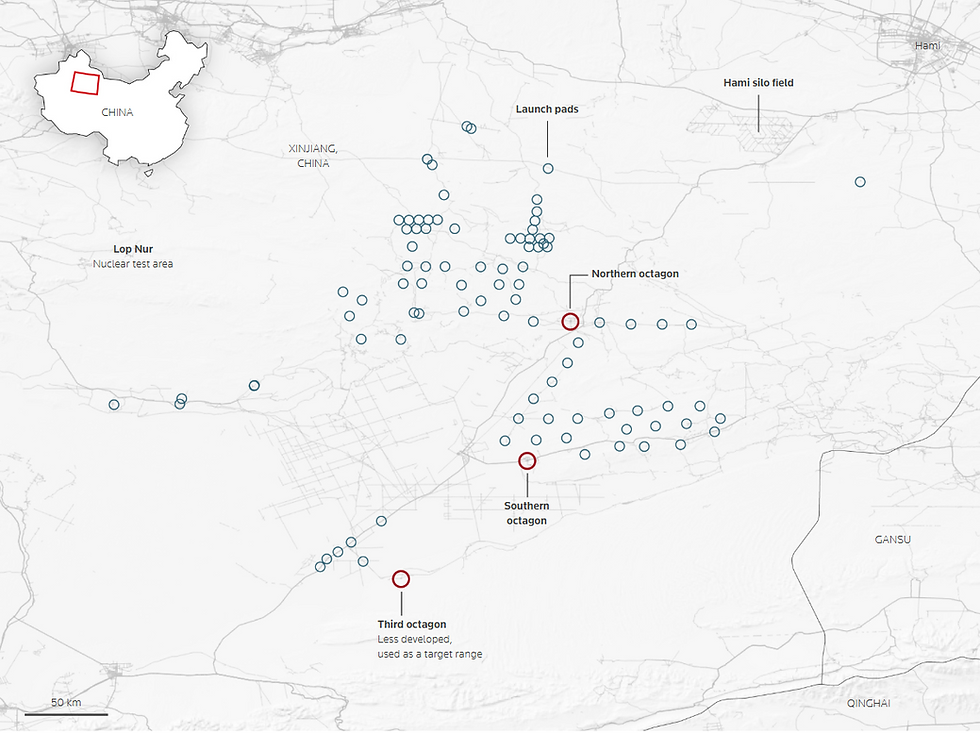
China is carrying out one of the most significant expansions of its strategic nuclear infrastructure in recent history, according to newly analysed satellite imagery that has drawn attention from security experts, military analysts and policymakers around the world.
The construction activity is unfolding across vast stretches of remote desert terrain in China's northwestern Xinjiang region, where Beijing has spent recent years building large missile silo complexes designed to house some of its most powerful nuclear weapons.
Now, satellite images reviewed by Reuters reveal an extensive network of military facilities surrounding those silo fields, including more than 80 launch-pad locations, fortified military installations, communications infrastructure, transportation links, command facilities and support structures spread across thousands of square kilometres.
Security analysts believe the project could significantly strengthen China's ability to preserve its nuclear forces during a conflict and ensure that it retains the capability to launch a retaliatory strike even after suffering an enemy attack.
The developments come amid growing strategic competition between China and the United States, rising tensions over Taiwan, and increasing international scrutiny of Beijing's rapidly expanding nuclear arsenal.
Why China's New Nuclear Infrastructure Is Raising Global Security Concerns
China already possesses intercontinental ballistic missiles (ICBMs) capable of reaching every major city in the United States.
However, the latest construction activity suggests Beijing is not merely expanding the size of its nuclear forces. Instead, it appears focused on improving their survivability, operational flexibility and ability to withstand a first strike.
According to analysts who reviewed the imagery, the newly identified facilities appear designed to support China's long-term objective of maintaining a credible second-strike capability.
In nuclear strategy, second-strike capability refers to a country's ability to retaliate with nuclear weapons even after suffering a nuclear attack.
For any nuclear power, ensuring survivability is essential because deterrence only works if potential adversaries believe retaliation remains possible.
The scale of the infrastructure now emerging in China's deserts suggests Beijing is investing heavily in ensuring exactly that.

Understanding China's Nuclear Strategy and No First Use Doctrine
For decades, China's nuclear policy has differed from those of the United States and Russia.
Rather than maintaining enormous nuclear stockpiles comparable to the Cold War arsenals of Washington and Moscow, Beijing has traditionally pursued what it describes as a policy of "minimum but credible deterrence."
Under this approach, China seeks to maintain enough nuclear weapons to discourage attacks without attempting to match the numerical superiority of other nuclear powers.
A cornerstone of this strategy is China's officially stated "No First Use" doctrine.
Under this policy, China says it would not be the first country to use nuclear weapons during a conflict.
Instead, its nuclear forces are intended to serve as a retaliatory deterrent.
This means China's strategic planners place enormous importance on ensuring that nuclear forces can survive an initial attack and remain capable of launching a response.
The new infrastructure in Xinjiang appears closely aligned with that objective.
What Is Second-Strike Capability and Why Does China Consider It Essential?
The concept of second-strike capability lies at the heart of modern nuclear deterrence.
Simply put, a country must convince its adversaries that any nuclear attack would trigger an unavoidable retaliatory response.
If an adversary believes it can destroy all of a country's nuclear forces in a surprise first strike, deterrence weakens.
To prevent this, nuclear powers invest heavily in systems designed to preserve their ability to retaliate.
These include:
Hardened missile silos
Mobile missile launchers
Submarine-based nuclear forces
Underground command centres
Early warning systems
Secure communications networks
Analysts say much of China's recent military construction appears aimed at improving these capabilities.
The emerging network around the Hami missile fields suggests Beijing wants to complicate any potential attempt to disable its nuclear arsenal through a single attack.
Where Is the Hami Nuclear Missile Silo Field Located?
The centrepiece of the newly observed military infrastructure is the Hami nuclear missile silo field.
Located in eastern Xinjiang, one of China's most remote regions, the site forms part of a broader network of strategic missile facilities stretching across northwestern China.
The Hami complex is widely regarded as one of the most important components of China's land-based nuclear forces.
Together with missile silo fields in neighbouring Gansu province, it serves as a core element of Beijing's strategic deterrent.
The location offers several advantages:
Geographic isolation
Vast open terrain
Low population density
Significant space for expansion
Natural defensive depth
These characteristics make the region well suited for large-scale strategic military infrastructure.
More Than 80 Launch Pads Discovered Near China's Nuclear Missile Silos
One of the most striking findings revealed by the satellite imagery is the discovery of more than 80 concrete launch-pad locations spread across the desert landscape surrounding the Hami silo field.
The launch pads are distributed across a vast area and connected through an extensive network of roads and supporting infrastructure.
According to analysts who reviewed the images, these sites could potentially support:
Mobile Missile Launchers
Road-mobile launchers carrying intercontinental ballistic missiles could be deployed from some of the larger pads.
Air Defence Systems
Several launch sites appear suitable for air-defence missile batteries designed to protect strategic facilities.
Electronic Warfare Operations
Some locations may support electronic warfare systems intended to disrupt enemy communications, sensors and targeting capabilities.
Military Support Operations
Additional sites could provide logistics, maintenance and operational support functions.
The sheer number of launch-pad locations suggests China is seeking to create a highly dispersed and resilient military network.
Why Security Analysts Believe the Infrastructure Is Linked to China's Nuclear Forces
Five security experts interviewed regarding the satellite imagery broadly agreed that the infrastructure could support China's strategic nuclear mission.
Although analysts caution that the precise function of every facility remains unknown, the overall pattern strongly suggests a connection to Beijing's expanding nuclear programme.
The launch-pad network is located near some of China's most important long-range missile deployments.
The surrounding facilities include:
Fortified bunkers
Weapons storage areas
Communications nodes
Airfields
Rail infrastructure
Military vehicle support facilities
Taken together, the infrastructure appears consistent with efforts to improve the survivability and operational readiness of strategic missile forces.
Alexander Neill, an adjunct fellow at Hawaii's Pacific Forum, highlighted the extraordinary scale of the project.
According to Neill:
"We can see this infrastructure is being built on a grand scale, covering thousands of square kilometers of desert beyond the silo fields."
He added that depending on the exact capabilities ultimately deployed, the project could represent:
"A very considerable enhancement and diversification of China's strategic nuclear deterrent."
How China's Desert Military Network Could Complicate Any Future Attack
Military planners generally prefer to know exactly where strategic weapons are located.
The emerging network around Hami appears designed to create uncertainty.
By building numerous launch sites, roads, bunkers and support facilities across a vast area, China may be making it much harder for an adversary to identify which locations contain active missile systems.
This creates what defence analysts often describe as a "targeting problem."
In a conflict scenario:
Mobile launchers can move between locations.
Multiple launch pads create uncertainty.
Hardened facilities increase survivability.
Dispersed infrastructure reduces vulnerability.
The result is a more resilient deterrent force.
For Beijing, this strengthens confidence that its nuclear forces could survive long enough to retaliate if attacked.
Why China's Nuclear Modernisation Is Becoming a Major Issue for Washington
China's nuclear expansion has become one of the most closely watched aspects of President Xi Jinping's military modernisation programme.
US officials and arms-control analysts increasingly view China's strategic build-up as one of the most significant shifts in the global nuclear balance.
Several Western diplomats have expressed concern regarding what they describe as limited transparency surrounding China's nuclear intentions and future force structure.
At the same time, attempts by the United States to engage Beijing in detailed discussions regarding nuclear arms control have achieved only limited success.
As China continues to expand its missile infrastructure, those concerns are likely to intensify further.
The newly discovered launch-pad network near Hami is therefore not merely a regional development. It has become part of a much broader debate about the future of nuclear competition between China and the United States.
The Mystery of China's Octagon-Shaped Military Complexes in Xinjiang
While the discovery of more than 80 launch-pad locations has attracted significant attention, security analysts believe the most intriguing aspect of China's desert military expansion may actually be two massive octagon-shaped installations located southwest of the Hami missile silo fields.
These unusual facilities sit at the centre of the newly emerging military network and appear to play a critical role in supporting China's strategic nuclear infrastructure.
Satellite imagery indicates that both complexes have been under construction for approximately six years and are surrounded by extensive support facilities, transportation links, bunkers and military activity.
For analysts studying China's nuclear modernization programme, these octagonal installations represent one of the most significant unanswered questions.
Where Are China's Octagon-Shaped Military Facilities Located?
The two primary octagon complexes are located in eastern Xinjiang, southwest of the Hami nuclear missile silo fields.
Northern Octagon
Located approximately:
140 kilometres from the Hami silo field
Southern Octagon
Located approximately:
230 kilometres from the Hami silo field
Both facilities occupy remote desert terrain and are connected to surrounding military infrastructure through extensive transportation and communications networks.
The locations were carefully selected in an isolated region where military operations can be conducted with minimal civilian interference.
Why Analysts Believe the Octagons Are Central to China's Nuclear Operations
Although the precise purpose of the octagons remains unknown, multiple security experts believe they are closely linked to China's strategic missile forces.
The scale and design of the facilities suggest they perform functions extending far beyond ordinary military bases.
Satellite imagery reveals:
Personnel housing areas
Large vehicle facilities
Fortified storage sites
Defensive infrastructure
Communications systems
Transportation links
The concentration of resources at these locations has led many analysts to conclude that the octagons may serve as operational hubs supporting China's missile forces.
Inside the Northern Octagon: What Satellite Images Reveal
Detailed satellite imagery provides an unusually clear view of the internal structure of the northern octagon.
The complex appears organised in multiple layers.
Central Core Building
At the centre of the installation sits a large primary structure.
Analysts believe this building may perform command, coordination or operational functions.
Ring of Personnel Buildings
Surrounding the central core is a ring of buildings believed to accommodate military personnel.
The arrangement suggests permanent occupation by a significant number of staff.
Vehicle Storage and Support Facilities
A third layer contains structures large enough to house military vehicles.
Security analysts believe these buildings could support:
Mobile missile launchers
Logistics vehicles
Air-defence systems
Engineering equipment
The ability to shelter large military vehicles is considered particularly significant because mobile launchers form an important component of modern strategic deterrence.
Outer Layer Infrastructure
Beyond the inner rings lie additional buildings whose exact purpose remains unclear.
These may include:
Maintenance facilities
Storage structures
Operational support buildings
Administrative areas
The sheer scale of development suggests a complex designed for sustained military activity.
Military Activity Observed Around the Northern Octagon
One of the most significant findings from recent satellite imagery involves military exercises conducted around the northern octagon during April and May 2026.
Images reveal evidence of active military operations in the surrounding desert.
Among the observations:
Large Military Vehicle Movements
Satellite imagery captured extensive vehicle activity near the facility.
Visible signs included:
Vehicle trails
Movement patterns
Temporary deployment areas
These indicators suggest regular operational exercises.
Temporary Structures and Large Tents
Analysts also identified numerous temporary structures around the installation.
These include:
Large tents
Temporary operational shelters
Field support facilities
Such structures often appear during military exercises and training operations.
Camouflaged Military Positions
Several locations appeared deliberately concealed within the surrounding terrain.
Security experts believe some of these may represent:
Temporary deployment sites
Camouflaged launch positions
Mobile missile operating areas
This interpretation aligns with China's broader emphasis on survivability and concealment.
Air Defence Systems May Be Protecting China's Strategic Missile Network
Another notable observation involves what analysts believe may be air-defence missile batteries positioned around parts of the complex.
If confirmed, these systems would serve an important purpose.
Strategic missile facilities are among the highest-priority targets during any major conflict.
Protecting them requires layered defensive systems capable of intercepting incoming threats.
Possible air-defence deployments around the octagons may therefore help:
Protect command facilities
Defend missile infrastructure
Secure communications nodes
Increase overall survivability
This would further strengthen China's second-strike capability.
Massive Transportation Infrastructure Supports China's Nuclear Expansion
One of the most striking aspects of the new military network is the extensive transportation infrastructure connecting the facilities.
The octagons are not isolated installations.
Instead, they are integrated into a broader logistics and support system stretching across the desert.
Rail Networks Connect Strategic Military Sites
Satellite imagery reveals railway infrastructure serving the southern octagon.
Visible facilities include:
Railway Lines
Connecting strategic locations throughout the region.
Rail Terminal
Capable of handling military equipment and supplies.
Rail transport offers an efficient method for moving:
Heavy equipment
Construction materials
Vehicles
Personnel
across large distances.
Airfields Enhance Operational Flexibility
Images also show airfield facilities near the southern octagon.
Airfields provide several advantages:
Rapid personnel transport
Emergency logistics support
Military aircraft operations
Strategic mobility
The presence of nearby airfields suggests the facilities are intended to support sustained military operations.
Fortified Storage Areas and Possible Fuel Facilities
Additional satellite imagery identifies several heavily protected sites.
Among them:
Possible Fuel Storage Installations
These facilities could support vehicle operations across the vast desert network.
Reinforced Bunkers
Potentially used for:
Equipment storage
Weapons storage
Protected command functions
Fortified Weapons Storage Areas
Analysts observed structures protected by:
Perimeter walls
Guard towers
Reinforced revetments
Such protection is consistent with facilities housing sensitive military assets.
Roads and Conduits Stretch Across Thousands of Square Kilometres
Perhaps the most remarkable feature of the network is its scale.
Both octagons sit at the centre of extensive road and conduit systems radiating across the surrounding desert.
These networks connect:
Launch pads
Storage facilities
Defensive positions
Communications nodes
The roads extend deep into isolated terrain, reaching locations concealed among rocky outcrops and dry creekbeds.
This geography provides natural concealment for military assets.
Could China Be Building a Strategic Communications Network?
Several experts believe the conduits linking various facilities may contain communications infrastructure.
Possible Fibre-Optic Networks
According to analysts Hans Kristensen and Alexander Neill, the conduits may house fibre-optic cables.
Such systems would allow:
Secure communications
Rapid data transmission
Resilient command networks
During a crisis, reliable communications become essential for maintaining control of nuclear forces.
Satellite Dishes and Towers Raise Questions About Command-and-Control Systems
One of the most intriguing discoveries involves construction activity at the northern octagon.
Analysts identified:
Large Satellite Dishes
Potentially supporting strategic communications.
Two Large Towers
Whose precise purpose remains unclear.
These structures have generated considerable interest among security specialists.
Some believe they may form part of a larger command-and-control architecture supporting China's strategic missile forces.
Experts Believe the Facilities May Support Nuclear Command Systems
Tong Zhao, Senior Fellow in Nuclear Policy at the Carnegie Endowment for International Peace, believes the available evidence points toward a broader operational role.
According to Zhao:
"Taken together, I think there is a real possibility that the octagonal structures and the strange towers are linked to C3 — command, control and communications — as well as maintenance and storage activities related to China's nuclear operations at the Hami ICBM silo site."
This assessment is significant because command-and-control systems are among the most important elements of any nuclear deterrent.
Without reliable communications, even the most powerful missile force becomes ineffective.
Why Command, Control and Communications Matter in Nuclear Strategy
Modern nuclear forces depend on what military planners call:
C3 Systems
Command
Control
Communications
These systems ensure:
Orders can be transmitted securely
Missile forces remain connected
Strategic decisions can be executed rapidly
Operations continue during crises
The newly observed infrastructure suggests China may be investing heavily in strengthening these capabilities.
If correct, the octagons may represent far more than simple support bases.
They could form the operational backbone of China's expanding strategic deterrent.
The Growing Significance of China's Desert Military Network
Taken individually, launch pads, roads, airfields and bunkers may not seem extraordinary.
Viewed together, however, they form a highly integrated military ecosystem.
The combination of:
Launch facilities
Transportation networks
Defensive systems
Communications infrastructure
Command facilities
suggests a coordinated effort to improve the survivability and effectiveness of China's nuclear forces.
For many analysts, the scale of the project is unlike anything previously observed in China's strategic missile programme.
The Third Octagon Near Lop Nur: A Different Military Purpose Emerges
While the northern and southern octagon complexes appear closely connected to China's strategic missile infrastructure, analysts identified a third octagon-shaped installation located south of the famous Lop Nur nuclear test site.
Unlike the other two facilities, this third complex appears less developed and may serve a very different role.
Satellite imagery reviewed by analysts shows:
Damaged structures
Impact-marked terrain
Training areas
Mock military targets
The available evidence suggests that the site may function primarily as a testing and target range rather than an operational missile-support facility.
Satellite Images Reveal Mock Western Fighter Aircraft
One of the most striking discoveries at the third octagon involves what analysts from commercial satellite imagery provider Vantor described as mock-ups resembling Western fighter aircraft.
Images reportedly show:
Mock Aircraft Targets
Used for training and testing purposes.
Damaged Buildings
Potentially serving as strike targets during exercises.
Pock-Marked Terrain
Indicating repeated impacts or weapons testing activities.
The presence of mock aircraft suggests the facility may be used to evaluate targeting systems, conduct military exercises, or test various weapon capabilities.
Unlike the octagons near Hami, however, this facility appears to play a supporting rather than operational role in China's broader strategic infrastructure.
China's Nuclear Arsenal Is Expanding Faster Than Almost Any Other Country
The newly discovered infrastructure must be understood within the broader context of China's ongoing nuclear modernisation programme.
Over the past decade, Beijing has significantly expanded both the size and sophistication of its nuclear forces.
According to U.S. officials and arms-control experts, China is currently modernising its strategic deterrent faster than any other major power.
Although Beijing still maintains a much smaller arsenal than the United States or Russia, the pace of development has attracted increasing attention from policymakers around the world.
Pentagon Projects China Could Reach 1,000 Nuclear Warheads by 2030
One of the most widely cited assessments comes from the Pentagon's annual report on China's military modernisation.
According to the report released in December:
China Could Possess Approximately 1,000 Nuclear Warheads by 2030
Although analysts note that warhead production growth has slowed compared with some earlier projections, the overall trajectory remains upward.
This would represent a substantial increase compared with China's historically smaller nuclear stockpile.
The Pentagon assessment highlights the extent to which Beijing is investing in long-term strategic capabilities.
China May Already Have Around 100 Loaded ICBMs in Missile Silos
The same Pentagon report estimated that China has likely loaded approximately:
100 Intercontinental Ballistic Missiles (ICBMs)
across its three principal missile silo fields.
These include facilities located in:
Xinjiang
Gansu
Other strategic regions of northwestern China
The newly observed infrastructure around Hami appears designed to support and protect these forces.
For military planners, survivability is just as important as the missiles themselves.
China's DF-5C Intercontinental Ballistic Missile Explained
China publicly showcased several nuclear-capable weapons during a major military parade held in Beijing in September 2025 to mark the 80th anniversary of the end of the Second World War.
Among the weapons displayed was the:
DF-5C Intercontinental Ballistic Missile
The DF-5C represents one of China's most powerful strategic weapons.
Key characteristics include:
Long-range capability
Ability to reach the continental United States
Nuclear payload capability
Strategic deterrence role
China also displayed mobile missile systems capable of carrying nuclear warheads.
These mobile platforms are particularly important because they are more difficult to locate and target than fixed missile silos.
The newly identified launch-pad network may eventually support some of these mobile systems.
How China's Early Warning Satellite Network Strengthens Its Nuclear Deterrent
A second-strike capability depends not only on missiles and silos but also on early warning systems.
Without sufficient warning, strategic forces may be destroyed before they can respond.
To address this challenge, China has invested heavily in space-based surveillance systems.
What Is China's Huoyan-1 Early Warning System?
According to U.S. officials, China has developed an increasingly sophisticated missile-warning network supported by:
Huoyan-1 Satellites
These satellites form part of an early warning architecture designed to detect incoming missile launches.
According to Pentagon assessments:
Detection Time
Incoming ICBMs can reportedly be detected within:
Approximately 90 seconds of launch
Alert Time
Warning information can reportedly reach command centres within:
Three to four minutes
This response window may be sufficient to allow Chinese strategic forces to react before incoming missiles strike their targets.
The existence of such systems complements the infrastructure now being built around the Hami missile fields.
Why China's Nuclear Expansion Is Closely Linked to Taiwan Tensions
China's nuclear modernisation cannot be viewed in isolation from broader geopolitical developments.
One of the most sensitive issues in international politics remains:
Taiwan
Beijing considers Taiwan part of its territory.
Taiwan's government rejects those claims.
The issue has become a major source of tension between China and the United States.
As military competition intensifies in the Indo-Pacific, analysts increasingly examine how China's strategic forces might influence future crisis scenarios.
Xi Jinping's Warning to Donald Trump
Earlier this month, Chinese President Xi Jinping reportedly warned U.S. President Donald Trump that mishandling disagreements over Taiwan could push relations toward what he described as:
"A dangerous place."
The statement reflected continuing tensions over sovereignty, regional security, and military competition.
For many analysts, China's nuclear modernisation forms part of a broader effort to strengthen its strategic position during periods of geopolitical confrontation.
Why Some Analysts Believe Nuclear Deterrence Could Influence a Taiwan Crisis
China officially maintains its No First Use policy.
However, some Western diplomats and analysts have argued that Beijing could potentially employ nuclear deterrence or nuclear coercion to discourage foreign intervention in a Taiwan-related conflict.
Under this view, strengthening second-strike capability may serve multiple purposes:
Deterring nuclear attack
Reducing external intervention risks
Enhancing strategic leverage
Supporting broader military objectives
Although there is significant debate regarding these possibilities, they remain an important subject of discussion among defence planners.
What Security Experts Say About China's Expanding Nuclear Infrastructure
Several prominent analysts have commented on the newly observed military network.
While all caution that important details remain unknown, they broadly agree that the scale of construction is extraordinary.
Alexander Neill's Assessment
Alexander Neill, an adjunct fellow at Hawaii's Pacific Forum, emphasized the unprecedented scope of the project.
According to Neill:
"We can see this infrastructure is being built on a grand scale, covering thousands of square kilometres of desert beyond the silo fields."
He believes the facilities could significantly enhance China's strategic nuclear deterrent.
Hans Kristensen's Analysis
Hans Kristensen, Director of the Federation of American Scientists' Nuclear Information Project, highlighted the uncertainty surrounding the infrastructure.
According to Kristensen:
"It is hard to rule anything out."
However, he also noted that the scale of the facilities makes them particularly noteworthy.
Speaking about the broader project, Kristensen remarked:
"I've never seen anything quite like it. It's an extraordinary effort."
For an analyst who has spent decades studying nuclear forces worldwide, that assessment carries considerable weight.
Tong Zhao's Views on China's Command Systems
Tong Zhao, Senior Fellow in Nuclear Policy at the Carnegie Endowment for International Peace, focused on the communications infrastructure.
According to Zhao:
"Taken together, I think there is a real possibility that the octagonal structures and the strange towers are linked to C3 — command, control and communications."
He also suggested the facilities may support:
Maintenance activities
Storage operations
Strategic command functions
linked to the Hami ICBM site.
Why Washington Is Increasingly Concerned About China's Military Growth
China's expanding nuclear capabilities have become a central concern for U.S. defence planners.
Washington has repeatedly highlighted concerns regarding:
Nuclear expansion
Missile technology
Military modernisation
Indo-Pacific security
The newly discovered infrastructure is likely to intensify those concerns.
Pete Hegseth's Warning at the Shangri-La Dialogue
Speaking at the Shangri-La Dialogue in Singapore, one of Asia's most important security forums, U.S. Defence Secretary Pete Hegseth directly addressed China's military growth.
According to Hegseth:
"There is rightful alarm regarding China's historic military buildup and the expansion of its military activities in the region and beyond."
He argued that maintaining a stable balance of power remains critical.
Why the Indo-Pacific Balance of Power Matters
Hegseth warned against any single power dominating the region.
According to him:
"A Pacific dominated by any hegemon would unravel the regional balance of power."
He added:
"No state, including China, can impose its hegemony and hold the security or prosperity of our nation and our allies in question."
The remarks reflect broader concerns among U.S. allies regarding China's growing military capabilities.
U.S. Calls for Higher Defence Spending Among Allies
During the same forum, Hegseth urged regional partners to strengthen their military capabilities.
He called on allies to increase defence expenditure toward:
3.5 Percent of GDP
arguing that stronger regional defence capabilities are necessary to maintain deterrence and stability.
What China's Nuclear Expansion Means for Global Security
The newly discovered military infrastructure in Xinjiang represents far more than a construction project.
It reflects a broader transformation in China's strategic capabilities.
The combination of:
Missile silos
Launch-pad networks
Communications systems
Airfields
Rail infrastructure
Early warning satellites
Command facilities
suggests a comprehensive effort to strengthen China's nuclear deterrent.
Whether viewed as a defensive measure designed to ensure second-strike capability or as part of a wider military modernisation programme, the scale of the undertaking is difficult to ignore.
Why China's Desert Military Network Could Reshape Nuclear Competition
The satellite imagery emerging from China's northwestern deserts offers a rare glimpse into one of the most significant military construction efforts underway anywhere in the world.
More than 80 launch pads, extensive transportation networks, fortified facilities, command-and-control infrastructure, and mysterious octagon-shaped complexes are collectively reshaping the strategic landscape.
For Beijing, the objective appears clear: ensuring that its nuclear forces remain survivable, credible and capable of retaliation under any circumstances.
For Washington and its allies, the expansion raises important questions about the future balance of power, nuclear deterrence, and strategic stability in the Indo-Pacific region.
As China continues modernising its military under President Xi Jinping, developments in Xinjiang will remain among the most closely watched indicators of how the global nuclear order may evolve in the years ahead.


Comments