Daily Current Affairs – 18 July 2025


Welcome to your one-stop destination for crisp, reliable, and exam-relevant Daily Current Affairs. The PRESS Pad delivers daily updates and smart summaries that go beyond the headlines and align perfectly with the evolving pattern of UPSC and other state-level examinations.
Today's edition features key updates including Swachh Survekshan 2024-25, Global Wetland Outlook 2025, Polavaram Banakacherla Link Project (PBLP), equal inheritance rights of tribal women, Central Adoption Resource Authority (CARA), Global Findex 2025, Matter–Antimatter Asymmetry, Akash Prime, Pradhan Mantri Virasat Ka Samvardhan (PM VIKAS), 8th Economic Census, Urban Wind Stilling Effect, SIMBEX Exercise, National Financial Reporting Authority (NFRA) and more...
Click Here to read the Monthly Current Affairs Pointers (CAP).
President of India confers Swachh Survekshan 2024-25 awards |
Swachh Survekshan 2024-25, themed on “Reduce, Reuse, Recycle”, marks the 9th annual edition of the world’s largest urban cleanliness survey, promoting sustainable waste practices.
The survey is conducted annually under the Swachh Bharat Mission (Urban) by the Ministry of Housing and Urban Affairs (MoHUA) to assess urban cleanliness across India.
Swachh Survekshan evaluates cities based on a three-fold methodology: data submitted by Urban Local Bodies (ULBs), document assessment, and on-ground field assessment verified by a third-party agency for transparency.
The survey is divided into two major components:
Swachh Survekshan Rankings (with 80% weightage) based on assessments.
Certification Framework (with 20% weightage) focusing on ODF+ (Open Defecation Free Plus), ODF++, and Water+ statuses — indicators of urban sanitation, faecal sludge management, and safe water use respectively.
Cities are categorized across five population-based tiers:
Million Plus Cities (>10 lakh population)
Big Cities (3–10 lakh)
Medium Cities (50,000–3 lakh)
Small Cities (20,000–50,000)
Very Small Cities (<20,000)
A total of 78 awards were presented in the 2024-25 edition, classified under four major categories recognizing diverse contributions and performances.
A notable new category introduced is the Super Swachh League Cities, featuring cities that showcased extraordinary, sustained cleanliness performance based on previous rankings.
Indore, Surat, and Navi Mumbai were the first cities to enter this elite Super Swachh League, reflecting consistent top-tier urban sanitation and innovation.
Under the Top 3 Cities in each population tier, cities like Ahmedabad, Bhopal, and Lucknow emerged as the leading Swachh Shehar (Clean Cities) in their respective categories.
Special category recognitions included awards for:
Ganga Towns (cities along the Ganga river with high sanitation benchmarks)
Cantonment Boards (military-managed townships)
SafaiMitra Suraksha (promoting safety of sanitation workers)
Mahakumbh (large-scale religious gatherings with mass sanitation efforts)
At the state level, 34 cities from various States/UTs were honored with Promising Clean Cities Awards, acknowledging rapid improvement or innovation.
As part of the 2024-25 edition, two new initiatives were also launched to strengthen urban sanitation ecosystems and foster cross-learning:
The Swachh City Partnership program will see all 78 top-performing cities mentor one poor-performing city from their state, promoting a peer-learning model of improvement.
The Accelerated Dumpsite Remediation Program is a one-year focused drive aimed at clearing legacy waste sites and enhancing scientific waste processing in cities — a critical step towards circular waste management.
Through these efforts, the Swachh Survekshan not only promotes cleanliness but also encourages citizen participation, fosters competitive spirit among cities, and helps make urban India more livable, safe, and sustainable.
Global Wetland Outlook 2025 released by Secretariat of the Ramsar Convention |
The Global Wetland Outlook 2025, released by the Secretariat of the Ramsar Convention, offers a comprehensive review of the health, status, and importance of wetlands globally.
Wetlands—defined as areas where water is the primary factor controlling the environment and life within it—include inland freshwater, coastal, and marine ecosystems, covering over 1,800 million hectares worldwide.
These ecosystems provide vital ecosystem services, broadly classified into provisioning (e.g., food, water, raw materials), and regulating services (e.g., air quality, climate regulation, waste treatment, erosion prevention, water flow control).
Wetlands also support genetic resources, contribute to biological control, moderate extreme climatic events (like floods), and offer ornamental resources, making them indispensable for ecological balance and human wellbeing.
However, wetlands are under serious threat—22% of the world’s wetlands have been lost since 1970, primarily due to unsustainable human activities and weak governance.
The degradation is more severe in low-income and lower-middle income countries (LICs/LMICs), with Africa's wetlands identified as among the most degraded globally, calling for urgent international support and conservation action.
Major drivers of wetland loss include unplanned urbanisation, rapid industrialisation, and unchecked infrastructure development, which disrupt the natural hydrological and ecological functions of these ecosystems.
The Ramsar Convention’s current strategic goals are closely aligned with the Kunming-Montreal Global Biodiversity Framework (KM-GBF)—a global agreement aimed at halting biodiversity loss and promoting nature-based solutions.
Promising case studies offer hope and inspiration:
The Regional Flyway Initiative, a US$3 billion partnership across Asia, is actively restoring over 140 wetlands critical to migratory birds and benefiting nearly 200 million people.
The Seychelles has become a pioneer by launching the world’s first sovereign “blue bond”, a financial tool aimed at marine conservation and sustainable fisheries — showcasing innovative wetland financing models.
The report emphasizes the “Way Forward”, urging nations to:
Integrate wetlands into national planning, especially through natural capital accounting (a method of valuing nature in economic planning).
Acknowledge wetlands’ central role in the global hydrological cycle, which regulates rainfall, groundwater, and climate.
Adopt innovative financial instruments like green bonds, blue bonds, and results-based financing to secure long-term funding for wetland restoration and conservation.
The Ramsar Convention, signed in 1971, is the only intergovernmental treaty dedicated to wetlands, providing a global framework for their conservation and wise use (sustainable utilisation without degrading their ecological character).
India ratified the Ramsar Convention in 1982, and has since designated several Ramsar Sites (wetlands of international importance), reflecting the country’s commitment to protecting these critical ecosystems.
Centre to form panel to resolve Polavaram Banakacherla Link Project (PBLP) |
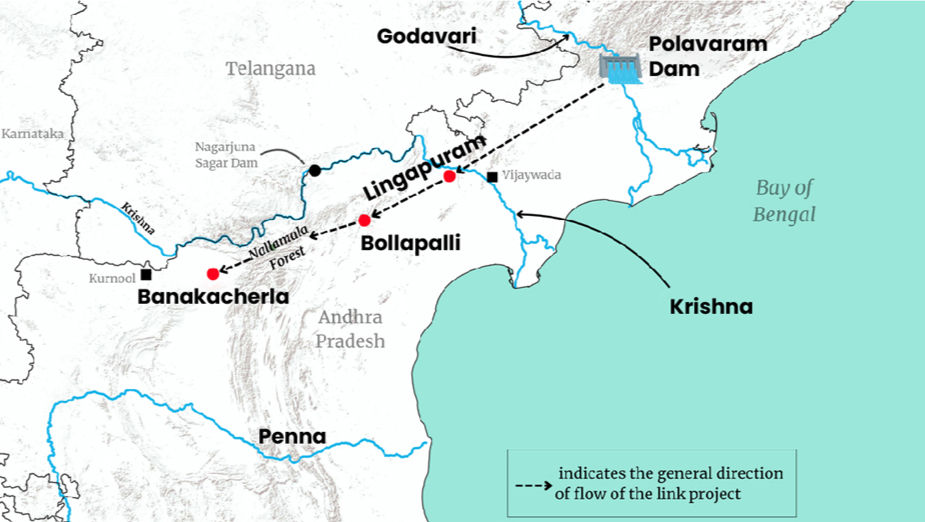
The Centre has decided to constitute a high-level technical committee to examine and address the long-pending inter-state water sharing issues between Telangana and Andhra Pradesh related to the Polavaram-Banakacherla Link Project (PBLP).
At the heart of the issue lies the Polavaram Project, a multipurpose national irrigation and water transfer initiative located on the Godavari River near Ramayyapeta village in Polavaram Mandal, Andhra Pradesh.
The main objectives of the Polavaram Project include irrigation development, hydropower generation, drinking water supply, and crucially, the diversion of surplus Godavari water to the Krishna river basin, to benefit the drought-prone Rayalaseema region of Andhra Pradesh.
The project has triggered tensions as Telangana has accused Andhra Pradesh of violating water-sharing terms laid down in the Andhra Pradesh Reorganisation Act, 2014, which governs river water usage post-bifurcation.
Telangana’s concern revolves around unilateral execution of water diversion schemes by Andhra, allegedly without adequate consultation or consent, potentially affecting its own share of river water.
To resolve such disputes, India has both statutory and constitutional mechanisms designed for fair adjudication and cooperative water management between states.
Under statutory provisions, the Inter-State River Water Disputes (ISRWD) Act, 1956 empowers the Central Government to set up Water Disputes Tribunals to settle river-related disputes between states.
Additionally, the River Boards Act, 1956 allows the Centre to establish River Boards, which are expert bodies to regulate and develop inter-state rivers and valleys collaboratively.
Constitutionally, Article 262 specifically empowers Parliament to make laws for adjudication of disputes relating to inter-state waters, thereby giving it legislative backing.
Importantly, Article 262 also states that the jurisdiction of the Supreme Court or any other court is barred in matters that are referred to a water dispute tribunal—making tribunals the final legal recourse.
Moreover, Entry 56 of the Union List in the Seventh Schedule of the Constitution authorizes the Central Government to regulate and develop inter-state rivers and river valleys, reinforcing its central role in dispute resolution.
In this backdrop, the formation of a technical committee on the Polavaram-Banakacherla Link Project reflects the Centre’s attempt to use a consultative, technical and legal mechanism to resolve growing tensions and uphold equitable inter-state water sharing.
Supreme Court Allows Tribal Women Equal Succession Rights As Men |
In a landmark decision, the Supreme Court has upheld the equal inheritance rights of tribal women, marking a progressive step towards gender justice in tribal communities.
The ruling came in the case of Ram Charan & Ors. vs. Sukhram & Ors., which challenged the denial of inheritance to women based on uncodified tribal customs.
The Court ruled that excluding tribal women from inheritance violates Articles 14 and 15 of the Indian Constitution, which guarantee equality before law and prohibit discrimination on grounds of sex.
When read with Articles 38 and 46, which promote social justice and protection of weaker sections, the judgment reaffirms the Constitution’s collective ethos of inclusivity and equality.
Although the Hindu Succession Act, 1956 does not apply to Scheduled Tribes under Section 2(2), the Court clarified that this exemption does not amount to automatic denial of women's succession rights.
In the absence of a valid and proven customary bar, courts are constitutionally obligated to apply the principles of justice, equity, and good conscience, especially where gender rights are concerned.
The judgment cited key precedents:
Mst. Sarwango v. Mst. Urchamahin (2013), which directed inheritance to daughters on the grounds of equity.
Tirith Kumar v. Daduram (2024), which upheld female inheritance rights in a tribal property dispute.
This verdict signifies a departure from the judiciary's earlier cautious stance on tribal customs, reflecting a shift toward progressive interpretation of customary laws in light of constitutional mandates.
The case also reopens the debate on the role of custom as a source of law — a system where long-standing social practices are recognized as legally binding, provided they meet standards of reasonableness and morality.
While customs have historically governed social conduct, the Court warned that regressive practices, such as Sati, child marriage, and triple talaq, show how customs can sometimes perpetuate inequality and obscurantism (i.e., resistance to rational and progressive change).
Thus, for any custom to hold legal weight, it must withstand constitutional scrutiny, promoting justice rather than entrenching discrimination or violating fundamental rights.
In essence, the Supreme Court’s decision in this case not only secures equal property rights for tribal women, but also reaffirms that customs cannot override constitutional values, particularly those ensuring equality, dignity, and non-discrimination.
CARA issues directions to states for strengthening counseling support at all stages of Child adoption |
The Central Adoption Resource Authority (CARA) has issued fresh directions to States/UTs to strengthen counseling and psychosocial support systems at every stage of the child adoption process.
These directions have been issued specifically to State Adoption Resource Agencies (SARAs) under the framework of the Juvenile Justice (Care and Protection of Children) Act, 2015 (amended in 2021), and are in line with the updated Adoption Regulations, 2022.
CARA emphasized the need to reinforce a comprehensive psychosocial support framework for all key stakeholders in the adoption process, including prospective adoptive parents (PAPs), adopted children, and biological parents.
In this context, SARAs have been instructed to designate or empanel qualified counsellors at both district and state levels, ensuring specialized mental health and emotional support throughout the adoption journey.
The directions also require provisions for psychosocial interventions to be made available in any exceptional or need-based circumstances, as assessed by either the Specialised Adoption Agencies (SAAs) or District Child Protection Units (DCPUs).
In India, child adoption is overseen by the Ministry of Women and Child Development, with the CARA acting as the nodal central authority, established under the Juvenile Justice Act to regulate and monitor adoption practices.
The primary legislation governing adoption includes the Hindu Adoption and Maintenance Act, 1956 (applicable to Hindus) and the Juvenile Justice Act, 2000/2015, which provides for adoption across all communities and ensures the child’s best interests.
India is also a signatory to the Hague Convention on Protection of Children and Cooperation in Respect of Intercountry Adoption, 1993, which establishes standards to ensure ethical, legal, and transparent international adoptions, and helps prevent child trafficking.
The responsibility for implementing these laws at the ground level lies with the States and Union Territories, which function through key institutions such as:
State Adoption Resource Agencies (SARAs)
Child Welfare Committees (CWCs)
District Child Protection Units (DCPUs)
As a statutory body under the Ministry of Women and Child Development, CARA regulates both in-country (domestic) and inter-country (international) adoptions to ensure that every adoption is in the best interest of the child.
CARA also serves as the designated Central Authority for inter-country adoption under the Hague Convention, a role that India formalized after ratifying the Convention in 2003.
Through its latest directions, CARA aims to embed a child-sensitive, psychologically aware adoption system, ensuring that emotional well-being and ethical safeguards remain at the core of every adoption case in India.
Global Findex 2025 |
The World Bank’s ‘Global Findex 2025’ report highlights global progress in financial and digital inclusion, with a specific focus on account ownership, usage, and barriers to access.
As per the report, India has achieved near-universal account ownership, with account penetration at or close to 90%, reflecting the success of initiatives like Jan Dhan Yojana, UPI, and Aadhaar-linked banking.
However, a significant challenge persists — 16% of Indian account holders have inactive accounts, meaning they did not use their account in the past 12 months, which is four times higher than the 4% average seen in other low- and middle-income economies (LMICs).
Inactive accounts, while showing inclusion on paper, indicate limited financial engagement, often due to lack of digital literacy, trust in formal banking, or relevant financial products.
On a positive note, the report shows a decline in the share of inactive accounts among both men and women in India between 2021 and 2024, signalling improved usage and financial participation.
The data also reveals that despite digital gains, mobile phone ownership remains a barrier for deeper financial inclusion, especially in rural and low-income segments.
The two primary barriers identified are the cost of mobile devices and unreliable mobile network coverage, both of which limit access to digital financial services like mobile banking, UPI apps, and online wallets.
These findings underline the importance of addressing infrastructure gaps and affordability issues, as digital tools are increasingly becoming the gateway to financial inclusion.
Overall, while India’s account ownership rate is commendable, the focus must now shift towards promoting account activity, closing the usage gap, and expanding digital accessibility for last-mile financial empowerment.
Matter–Antimatter Asymmetry |
Scientists at CERN have achieved a major breakthrough in understanding the mystery of the universe’s composition by observing CP violation in baryons for the first time.
This finding adds crucial evidence to solving the long-standing puzzle of matter–antimatter asymmetry, one of the fundamental open questions in modern cosmology and particle physics.
Matter–antimatter asymmetry refers to the observed imbalance between matter and antimatter in the universe, despite theoretical predictions suggesting they should have been created in equal amounts during the Big Bang.
According to current physics models, the Big Bang should have produced equal parts of matter and antimatter, which, upon meeting, would annihilate each other — yet the observable universe is dominated by matter, with almost no antimatter.
To explain this imbalance, scientists study CP violation, which refers to the breaking of CP symmetry, a condition under which the laws of physics should remain unchanged if particles are swapped with their antiparticles (C: charge conjugation) and viewed in a mirror image (P: parity transformation).
CP symmetry implies that matter and antimatter should behave identically under these combined transformations, but when CP violation occurs, it means matter and antimatter behave differently — a crucial clue to why the universe didn't annihilate itself after the Big Bang.
Previously, CP violation had been observed in certain mesons (particles made of quark-antiquark pairs), but the new CERN discovery confirms CP violation in baryons — particles like protons and neutrons that form the bulk of visible matter.
This observation provides strong experimental support to theories suggesting that tiny asymmetries in particle behavior during the early universe could have led to the matter-dominated cosmos we see today.
The discovery is a step forward in efforts to unify cosmological observations with the Standard Model of Particle Physics, which currently lacks a complete explanation for the matter–antimatter imbalance.
Overall, this development not only deepens our understanding of fundamental symmetries of nature but also brings us closer to explaining why anything exists at all, making it one of the most significant findings in high-energy physics in recent years.
Akash Prime |
In a significant boost to India’s air defence capability, Akash Prime successfully intercepted and destroyed two high-speed aerial unmanned targets during trials conducted at high altitude in Ladakh.
Akash Prime is an upgraded version of the indigenous Akash Surface-to-Air Missile (SAM) system, specifically developed by the Defence Research and Development Organisation (DRDO).
It is designed to be a rugged, all-terrain air defence system, capable of functioning under extreme operational conditions, including very low temperatures, high-altitude zones (above 4500 meters), and low-oxygen environments typical of Himalayan regions.
Unlike conventional SAM systems, Akash Prime has enhanced performance in cold and hostile climates, making it particularly suited for border deployment in regions like Ladakh and the North-Eastern frontiers.
The system retains the core capabilities of the original Akash missile, which includes intercepting aerial threats like fighter jets, cruise missiles, and UAVs (unmanned aerial vehicles), but is optimized for high-altitude warfare.
The successful demonstration reflects India’s growing emphasis on self-reliance in defence (Atmanirbhar Bharat) and on equipping its forces with indigenously built, terrain-specific combat systems.
Overall, Akash Prime represents a major advancement in India’s layered air defence network, ensuring reliable protection of sensitive border installations and forward bases in the most challenging operational environments.
Pradhan Mantri Virasat Ka Samvardhan (PM VIKAS) |
The Government has launched a new Skill Training and Women Entrepreneurship Development project under the PM VIKAS scheme, with training programs initiated at IIIT Kottayam specifically for minority candidates.
PM VIKAS (Pradhan Mantri Virasat Ka Samvardhan) is a Central Sector Scheme implemented by the Ministry of Minority Affairs, aimed at the holistic development of minority communities in India.
The scheme is a convergence of five earlier standalone schemes—Seekho Aur Kamao, Nai Manzil, Nai Roshni, USTTAD, and Hamari Dharohar, thereby streamlining efforts in skill development, education, entrepreneurship, and heritage preservation.
The core objective of PM VIKAS is the economic empowerment of six notified minority communities through targeted interventions in skill training, entrepreneurship development, and educational support, especially for school dropouts and minority women.
The six officially recognized minority communities in India include Muslims, Christians, Sikhs, Buddhists, Jains, and Zoroastrians (Parsis)—as per the National Commission for Minorities Act, 1992.
PM VIKAS gives special focus to leadership development among minority women, thereby promoting social inclusion, gender equity, and community leadership from within disadvantaged groups.
The scheme is being implemented in convergence with the Skill India Mission, which ensures standardized training modules, certification, and job linkage opportunities for beneficiaries, aligned with national skill development frameworks.
By integrating skill building with cultural preservation and livelihood support, PM VIKAS represents a comprehensive approach to minority welfare, reinforcing the government’s commitment to inclusive and equitable development.
8th Economic Census |
The Ministry of Statistics and Programme Implementation (MoSPI) has urged the integration of the preliminary work for the 8th Economic Census with the upcoming 16th Population Census, to enable efficient data collection and avoid duplication of efforts.
The Economic Census is a comprehensive exercise conducted by MoSPI to capture the complete enumeration of entrepreneurial activities—both formal and informal—across India at a specific point in time.
Its core objective is to provide disaggregated data on various aspects of economic establishments such as ownership patterns, number of persons engaged, and the geographical distribution of economic activities, down to the village and ward level.
Such detailed datasets serve as vital inputs for policymaking, sectoral planning, and allocation of resources for development schemes targeting MSMEs, informal sector workers, and region-specific economies.
The Economic Census is distinct from the Population Census, which focuses on demographic information; however, integrating both at the field level ensures cost efficiency, logistical synergy, and data consistency across national databases.
The census has been conducted periodically in the past—specifically in the years 1977, 1980, 1990, 1998, 2005, 2013, and 2019, with each round improving the scope and methodology of enterprise data collection in India.
The upcoming 8th Economic Census will likely leverage digital platforms and geospatial tools to enhance real-time verification, improve accuracy, and better capture the diversified nature of India’s entrepreneurial landscape.
Overall, integrating economic and population census activities reflects a strategic move towards building a robust, unified national statistical infrastructure, crucial for evidence-based governance and tracking India's economic transformation.
Urban Wind Stilling Effect |
A recent study has revealed that the Urban Wind Stilling Effect contributes to the formation of Urban Aerosol Clean Islands in North India, particularly across the northwest and northern Indo-Gangetic Plain.
It was observed that 43% of cities in this region exhibit lower aerosol concentrations than surrounding rural areas, leading to cleaner urban air pockets termed Urban Aerosol Clean Islands.
Aerosols are tiny particles or droplets—colloids—suspended in a gas, such as fog, clouds, smoke, or dust, which significantly impact air quality and climate.
The Urban Wind Stilling Effect arises because urban structures like buildings weaken surface-level winds, reducing airflow velocity near the ground.
This weakening creates invisible barriers that limit the entry of long-range transported dust and pollutants into these urban areas, effectively reducing aerosol accumulation compared to rural surroundings.
Hence, despite urban pollution sources, these cities paradoxically have cleaner aerosol conditions due to restricted pollutant inflow caused by the wind stilling phenomenon.
This finding highlights the complex interaction between urban architecture, local meteorology, and air quality, suggesting urban design influences not only emissions but also pollutant dispersion dynamics.
32nd Edition of SIMBEX Exercise |
The Indian Navy is set to participate in the 32nd edition of the Singapore India Maritime Bilateral Exercise (SIMBEX), which will be held in Singapore.
The exercise originated in 1994 under the name Exercise Lion King, marking the beginning of a strong maritime partnership between the two navies.
Since then, SIMBEX has evolved into an annual bilateral naval exercise between the Indian Navy and the Republic of Singapore Navy, making it one of India’s longest uninterrupted maritime drills.
This exercise plays a crucial role in enhancing interoperability, tactical proficiency, and maritime cooperation between India and Singapore in the strategically important Indo-Pacific region.
SIMBEX aligns closely with India’s broader strategic frameworks like Vision SAGAR (Security and Growth for All in the Region), which emphasizes maritime security and regional cooperation.
Additionally, it supports the Act East Policy, which focuses on strengthening economic and strategic ties with Southeast Asian nations, underlining India’s commitment to regional peace and stability.
National Financial Reporting Authority (NFRA) |
The Appointments Committee of the Cabinet has recently appointed a new chief for the National Financial Reporting Authority (NFRA), underscoring its continuing importance.
NFRA was established in 2018 by the Government of India under the provisions of the Companies Act, 2013, aiming to strengthen financial reporting standards.
Headquartered in New Delhi, NFRA serves as an independent regulatory body overseeing accounting and auditing practices in India.
Its primary functions include recommending accounting and auditing policies and standards for adoption by companies, ensuring uniformity and transparency in financial reporting.
NFRA is also mandated to monitor and enforce compliance with these accounting and auditing standards, thereby enhancing the reliability of corporate financial statements.
Additionally, the authority oversees the quality of services provided by accounting and auditing professionals, ensuring ethical and professional conduct within the industry.
Beyond these roles, NFRA performs other necessary or incidental duties to maintain the integrity and effectiveness of financial reporting in India.
Explore more on UPSC Content
Click for Daily Quotes:
Stay updated with the latest news by joining our Telegram channel – The PRESS Pad , and follow us on Instagram and X.


Comments