Daily Current Affairs - 1st & 2nd March 2026
- Kaushal
- Mar 7
- 19 min read
Comprehensive UPSC Current Affairs Summary | India–Canada CEPA Talks & Strategic Partnership, US–Iran Escalation & Strait of Hormuz Crisis, West Asia Impact on India’s Energy & Trade, Major Indian Ocean Straits, Nine FTAs & Export Growth, MFN Status in Services, New GDP Series (Base Year 2022–23), East Coast Industrial Corridor Push, India as Maritime Powerhouse, Rice Fortification Pause under PMGKAY, Arbitration Reforms & Challenges, Contempt of Court Framework, AI for Gender Empowerment Casebook and more.
Table of Content
SOCIAL ISSUES
Visit of the Prime Minister of Canada to India
The visit of the Prime Minister of Canada to India has concluded.
India–Canada relations were formally designated as a “Strategic Partnership” in 2018.
A Strategic Partnership refers to a structured and long-term framework of cooperation across political, economic, and security domains.
This visit marked the first bilateral visit to India by a Canadian Prime Minister since 2018.
Key Outcomes of the Visit

1. Trade Agreement
Both countries signed the Terms of Reference (ToR) for the Comprehensive Economic Partnership Agreement (CEPA).
The Terms of Reference outline the scope, objectives, and framework for negotiations.
CEPA refers to a broad-based trade agreement covering goods, services, investment, and economic cooperation.
Bilateral merchandise trade currently stands at approximately US$8–9 billion annually.
This trade volume is significantly below the potential relative to the economic size of both countries.
2. Nuclear Energy Cooperation
A long-term commercial contract was finalized with Cameco.
The contract provides for the supply of Uranium Ore Concentrates.
Uranium Ore Concentrates are processed uranium materials used as fuel in nuclear reactors.
3. Critical Minerals Cooperation
Both sides signed a Memorandum of Understanding (MoU) on critical minerals cooperation.
The MoU aims to develop secure and resilient critical mineral supply and value chains.
Critical minerals are essential raw materials required for clean energy technologies, electronics, and defence applications.
4. Joint Pulse Protein Centre of Excellence
A Declaration of Intent was signed for establishing a Joint Pulse Protein Centre of Excellence.
Canada is a major exporter of pulses to India.
Pulses are leguminous crops such as lentils and peas that serve as key protein sources.
Key Announcements
Both countries set a target to increase bilateral trade to US$50 billion by 2030.
Canada announced its decision to join the Global Biofuels Alliance.
Canada also announced joining the International Solar Alliance.
An India–Canada Parliamentary Friendship Group will be formed.
A India–Canada Defence Dialogue mechanism will be established.
The outcomes collectively aim to deepen economic cooperation, strengthen energy security, and enhance strategic engagement between the two countries.
U.S. and Israeli Airstrikes on Iran
The United States conducted airstrikes on Iran under “Operation Epic Fury.”
The strikes reportedly resulted in the killing of Iran’s Supreme Leader, Ali Khamenei.
The development has sharply escalated tensions in the Middle East.
Iran retaliated through missile and drone attacks.
The retaliation further intensified regional instability.
Background of the Current Escalation

1. Post-1979 Hostility
Relations between the United States and Iran have remained strained since the 1979 Islamic Revolution.
The Islamic Revolution led to the overthrow of the Shah and establishment of a theocratic regime in Iran.
The period has been marked by sanctions, diplomatic breakdown, and ideological rivalry.
Sanctions refer to economic and political restrictions imposed to influence a country’s behaviour.
2. Nuclear Dispute
Tensions escalated over Iran’s nuclear programme.
The dispute intensified after the U.S. withdrew from the Joint Comprehensive Plan of Action (JCPOA) in 2018.
The JCPOA was signed in 2015 between Iran and major world powers to limit Iran’s nuclear activities in exchange for sanctions relief.
Following withdrawal, the U.S. re-imposed economic sanctions on Iran.
3. Proxy Warfare and Regional Influence
Iran has supported allied non-state actors in the region.
These include Hamas and Hezbollah.
These groups operate in Lebanon, Syria, Iraq, and Yemen.
Proxy warfare refers to indirect conflict where states support non-state actors or allied groups.
Iran’s regional footprint has raised security concerns for the U.S. and Israel.
Consequences of the Conflict
1. Regional Instability
The escalation increases the risk of a wider Middle East conflict.
Missile and drone strikes have targeted U.S. military bases and allied locations.
Such attacks have been reported in Gulf countries including the United Arab Emirates.
2. Threat to Energy Security
Iran has reportedly closed the Strait of Hormuz.
The Strait of Hormuz is a critical maritime chokepoint.
Around 20% of the world’s oil trade passes through this route annually.
Energy security refers to uninterrupted access to affordable energy supplies.
Disruption can lead to global oil price spikes.
3. Global Trade and Connectivity
Maritime insecurity in the Gulf increases freight costs.
Insurance premiums for shipping are also likely to rise.
Key shipping lanes may face disruption.
Global supply chains dependent on West Asian energy flows may be disturbed.
4. Nuclear Escalation Risk
The conflict raises the risk of strategic miscalculation.
Strategic miscalculation refers to unintended escalation due to incorrect assessment of adversary actions.
There is a potential risk of nuclear escalation.
Nuclear escalation refers to the expansion of conflict involving nuclear capabilities.
Impact on India
India imports nearly 85% of its crude oil requirements.
A significant portion of these imports comes from West Asia.
Rising oil prices can widen India’s Current Account Deficit (CAD).
Current Account Deficit refers to the excess of imports of goods, services, and transfers over exports.
Higher oil prices can also fuel domestic inflation.
Around 8–9 million Indians reside in the Gulf region.
Diaspora safety becomes a key policy concern during conflict.
Remittance stability may also be affected.
Remittances are funds sent by overseas Indians to their families in India.
Large-scale evacuation may become necessary if the conflict intensifies.
Government Reviews Impact of West Asia Crisis
The Government of India has assessed the potential impact of the ongoing conflict in West Asia on the Indian economy.
Inter-ministerial deliberations were held with exporters and logistics stakeholders to evaluate the risks.
West Asia refers to the region commonly known as the Middle East.
The region is strategically significant for India’s energy, trade, and diaspora interests.
1. Threat to Energy Security
A major concern is the possible disruption of the Strait of Hormuz.
The Strait of Hormuz accounts for roughly 20% of global oil trade.
It carries around 85% of India’s LPG supplies.
LPG (Liquefied Petroleum Gas) is used for domestic cooking and industrial applications.
It also carries nearly 55% of India’s LNG supplies.
LNG (Liquefied Natural Gas) is natural gas cooled to liquid form for easier transport.
India depends on imports for more than 85% of its crude oil requirements.
A substantial portion of these imports originates from West Asia.
Energy security refers to the uninterrupted availability of energy at affordable prices.
2. Impact on Trade
Approximately 56% of India’s goods exports are exposed to uncertainty due to instability in the region.
West Asia is a major export destination for India.
The region also acts as a key transit corridor connecting India to Europe and Africa.
A transit corridor is a trade route facilitating movement of goods between regions.
Disruptions may adversely affect India’s export competitiveness.
3. Supply Chain Disruptions
Shipping disruptions are increasing insurance costs and transit time.
Higher insurance premiums raise overall logistics expenses.
Transit time refers to the duration taken for goods to reach their destination.
Major Gulf transshipment hubs are at risk.
Transshipment hubs are ports where cargo is transferred from one vessel to another.
Key affected ports include Jebel Ali Port and Port of Salalah.
4. Impact on Indian Diaspora
Indians constitute nearly 30% of the total expatriate workforce in the Gulf Cooperation Council (GCC) countries.
The GCC includes Saudi Arabia, UAE, Qatar, Kuwait, Oman, and Bahrain.
Instability may affect employment conditions of Indian workers in the region.
5. Impact on Remittances
Around 19% of India’s total remittances originate from the UAE.
Approximately 7% of remittances come from Saudi Arabia.
Kuwait, Oman, and Qatar also contribute significantly to remittance inflows.
These figures are based on the RBI Remittances Survey 2023–24.
Remittances refer to money sent by overseas workers to their home country.
Remittances are an important source of foreign exchange earnings for India.
6. Impact on Strategic Connectivity Projects
The crisis may affect the development of the International North-South Transport Corridor (INSTC).
The INSTC is a multi-modal transport corridor linking India with Russia and Europe via Iran and Central Asia.
It may also impact the India-Middle East-Europe Economic Corridor (IMEC).
IMEC is a proposed connectivity corridor linking India to Europe through the Middle East.
The crisis could also affect the Chabahar Port.
Chabahar Port provides India access to Afghanistan and Central Asia bypassing Pakistan.
Overall Assessment
The West Asia crisis poses risks to energy security, trade flows, supply chains, diaspora welfare, remittance stability, and strategic connectivity initiatives.
The government’s consultations aim to develop contingency strategies to mitigate potential economic shocks.
Major Straits in Indian Ocean
Iran has vowed to attack any ship trying to pass through the Strait of Hormuz.
About Straits:
Meaning: It is a naturally formed narrow passage of water that links two larger water bodies, such as seas or oceans.
Major Straits in Indian Ocean:
Strait of Hormuz: Connects Persian Gulf with Gulf of Oman and Arabian Sea.
Bab-el-Mandeb Strait: Connects the Red Sea with the Gulf of Aden and Indian Ocean.
Malacca Strait: Connects Andaman Sea (Indian Ocean) and the South China Sea (Pacific Ocean).
India Concludes Nine FTAs in Three Years
1.India has concluded nine Free Trade Agreements (FTAs) covering 38 countries in the last three years.
FTAs are trade agreements that reduce or eliminate customs duties and other trade barriers between participating countries.
2.These agreements have resulted in zero-duty market access to nearly 70% of global GDP.
Zero-duty access means Indian exports can enter partner markets without import tariffs.
3.India’s cumulative exports reached USD 720.76 billion during April–January 2025–26.
4.This marks a 6.15% year-on-year (YoY) growth.
YoY growth refers to the percentage increase compared to the same period in the previous year.
Sector-wise Export Performance
1. Electronic Goods
Electronic goods have emerged as India’s third-largest export category.
India has become the world’s second-largest mobile phone manufacturer.
This growth reflects increasing integration into global electronics supply chains.
2. Petroleum Products
India is the seventh-largest global exporter of refined petroleum products.
Refined petroleum products include diesel, petrol, and aviation turbine fuel.
India imports crude oil and exports refined fuels after processing.
3. Pharmaceuticals
India is consolidating its position as the “Pharmacy of the World.”
India ranks as the third-largest pharmaceutical producer globally by volume.
It ranks as the 11th largest by value.
Production by volume refers to quantity manufactured.
Production by value refers to the monetary worth of output.
4. Automobiles and Textiles
The automobile sector provides direct and indirect employment to over 30 million people.
Direct employment refers to jobs within the sector.
Indirect employment includes jobs generated in supply chains and ancillary industries.
The textiles sector holds the sixth-largest share in global textile exports.
Textiles remain a labour-intensive and export-oriented industry.
5. Defence Exports
India’s defence exports have expanded to over 100 countries.
Defence exports reached ₹23,622 crore in FY25.
This reflects growth in indigenous defence manufacturing.
Institutional Support Mechanisms
1. Export Promotion Mission (EPM)
The Export Promotion Mission (EPM) is backed by an outlay of ₹25,060 crore for FY26–FY31.
It aims to empower MSMEs and first-time exporters.
MSMEs refer to Micro, Small, and Medium Enterprises.
The mission operates through initiatives such as Niryat Protsahan and Niryat Disha.
These initiatives provide guidance and support to exporters.
2. Logistics and Warehousing Support
Initiatives such as FLOW and LIFT provide support for overseas warehousing.
They help offset freight disadvantages faced by exporters in low-export districts.
Freight disadvantage refers to higher transportation costs affecting competitiveness.
3. TRACE Initiative
The TRACE initiative reimburses costs related to international testing, inspection, and certification.
Testing and certification are often mandatory for accessing global markets.
This reduces compliance burdens on exporters.
Government Schemes and Manufacturing Push
1. Production-Linked Incentive (PLI) Schemes
PLI schemes operate in sectors such as Automobiles, Bulk Drugs, and Medical Devices.
They aim to reduce dependence on critical imports.
PLI provides financial incentives based on incremental production.
2. Technology and Electric Vehicle Push
The India Semiconductor Mission 2.0 promotes domestic semiconductor manufacturing.
Semiconductors are essential components used in electronics and digital devices.
The Electronics Component Manufacturing Scheme (ECMS) has an outlay of ₹40,000 crore.
The PM E-DRIVE scheme has an allocation of ₹10,900 crore.
These initiatives accelerate domestic manufacturing and promote self-reliance in emerging technologies.
Self-reliance refers to reducing dependency on foreign supply chains.
Most Favoured Nation (MFN)
The European Union and India have agreed to grant each other Most Favoured Nation status (MFN) in Trade in Services for a period of five years.
About Most Favoured Nation
The MFN principle is a fundamental rule of the World Trade Organization (WTO).
According to it, if a WTO member grants favourable trading terms like lower tariffs to one country, it must extend the same benefits to all other WTO members.
Exceptions exist for Regional Trade Agreements (RTAs), FTAs, and developing countries.
New Series of Gross Domestic Product (GDP) Released
The Ministry of Statistics and Programme Implementation (MoSPI) has released the New Series of Annual and Quarterly National Accounts Estimates, including revised Gross Domestic Product (GDP) data.
GDP refers to the total monetary value of all final goods and services produced within a country during a specific period.
National Accounts Estimates measure the size, structure, and performance of the economy.
Key Changes in the New GDP Series
1. New Base Year
The new base year has been revised to 2022–23.
The earlier base year was 2011–12.
A base year is the reference year against which real growth is calculated.
FY 2022–23 was selected as it represents the most recent “normal” year after the COVID-19 disruptions of 2019–2021.
2. New Data Sources
The revised series integrates high-frequency and administrative data sources.
High-frequency data refers to data collected at short intervals such as monthly or quarterly.
Administrative data refers to records generated through government systems.
New sources include GST collections.
GST refers to Goods and Services Tax, an indirect tax on goods and services.
The series incorporates data from the e-Vahan portal.
The e-Vahan portal contains vehicle registration and transport-related data.
It also integrates the Public Financial Management System (PFMS).
PFMS is a platform for tracking government expenditure and fund flows.
3. Refined Deflation Techniques
The revised series adopts Double Deflation in manufacturing and agriculture.
Double deflation adjusts both input prices and output prices to calculate real value added.
Earlier, Single Deflation was used.
Single deflation adjusts only output prices while keeping input prices unchanged.
4. Integration of Supply and Use Tables (SUT)
The Supply and Use Tables (SUT) framework has been aligned with National Accounts.
SUT tracks the supply of goods and services and their corresponding use in the economy.
This alignment reduces discrepancies between production-based and expenditure-based GDP estimates.
Production-based GDP measures output from industries.
Expenditure-based GDP measures spending by households, businesses, government, and net exports.
5. Improved Estimation of Private Final Consumption Expenditure (PFCE)
Estimation of Private Final Consumption Expenditure (PFCE) has been improved.
PFCE refers to total spending by households on goods and services.
The revision integrates direct production data.
It also uses administrative data sources.
The commodity flow approach has been incorporated.
The commodity flow approach estimates consumption based on supply of goods adjusted for trade and inventories.
6. General Government Adjustments
Government estimates now incorporate the rollout of the National Pension System (NPS).
The NPS is a contributory pension scheme for government employees and citizens.
The estimates also account for the Old Pension Scheme (OPS).
The OPS provides defined pension benefits funded by the government.
7. Other Inclusions
The revised series includes hired domestic workers.
It captures digital, platform, and gig economy activities.
The gig economy refers to short-term and freelance-based employment arrangements.
Data from the Annual Survey of Unincorporated Sector Enterprises (ASUSE) has been included.
ASUSE measures activity in small and informal enterprises.
Data from the Periodic Labour Force Survey (PLFS) has also been integrated.
PLFS provides employment and labour force statistics.
These inclusions improve measurement of the household and informal sectors.
Why Has the GDP Base Year Been Revised?
1. Structural Shifts
The revision reflects structural changes in the economy over the last decade.
It captures expansion of digital services.
It incorporates growth in renewable energy.
It accounts for evolving consumption patterns.
Structural shifts refer to long-term changes in the composition of the economy.
2. Alignment with International Best Practices
Periodic base year revisions align with global standards.
Such revisions are recommended by the United Nations Statistical Commission.
International best practices ensure comparability across countries.
Implications of the New Series
1. Decrease in Nominal GDP Size
The real growth rate for FY 2025–26 has increased to 7.6%.
Real growth rate measures economic expansion adjusted for inflation.
However, the nominal GDP size has been revised downward.
Nominal GDP measures output at current market prices.
The economy’s size has been reduced by roughly 3.3% to 3.8% for 2023–26 compared to earlier estimates.
Nominal GDP for FY 2025–26 is estimated at ₹345.47 lakh crore.
2. Higher Fiscal Deficit
The lower GDP base increases the fiscal deficit ratio.
The revised fiscal deficit for FY 2025–26 has increased from 4.36% to 4.51% of GDP.
Fiscal deficit refers to the gap between government expenditure and revenue.
3. Higher Debt-to-GDP Ratio
The Debt-to-GDP ratio for FY 2026–27 is now estimated at 57.5%.
The earlier budgeted target was 55.6%.
Debt-to-GDP ratio measures the proportion of government debt relative to economic output.
The revision complicates the government’s target of reducing central debt to 50% of GDP by 2031.
Industrial Corridors: Strengthening India’s Industrial Ecosystem
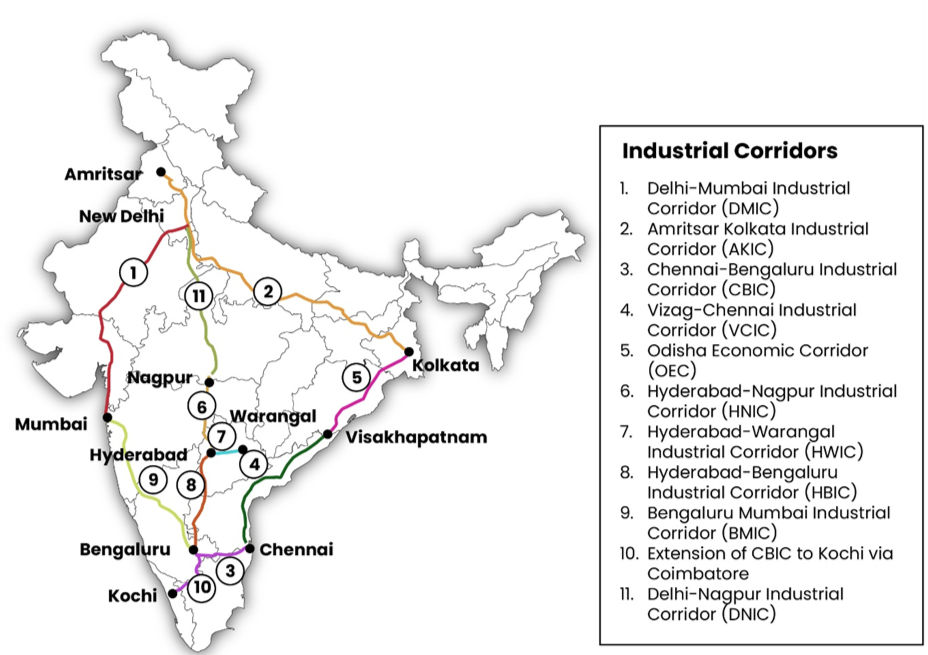
The Union Budget 2026–27 announced the development of an integrated East Coast Industrial Corridor.
The corridor will include a well-connected node at Durgapur.
This reflects a renewed policy thrust on Industrial Corridors.
About Industrial Corridors
Industrial Corridors are linear development zones.
They connect major economic centres through integrated infrastructure networks.
These networks include roads, railways, ports, and airports.
They aim to create globally comparable infrastructure.
They promote economic agglomeration.
Economic agglomeration refers to clustering of industries to benefit from shared infrastructure and reduced costs.
They leverage regional strengths through focused investments.
National Industrial Corridor Programme (NICDP)
The National Industrial Corridor Programme (NICDP) oversees development of multiple industrial corridors.
Projects are being implemented across 11 industrial corridors.
The framework emphasises sustainability.
It supports development of Low-Carbon Cities (LCCs).
Low-Carbon Cities are urban areas designed to minimise greenhouse gas emissions.
The programme is implemented by the National Industrial Corridor Development Corporation (NICDC).
NICDC was earlier known as the Delhi Mumbai Industrial Corridor Development Corporation Limited (DMICDC).
It was incorporated in January 2008.
It functions as an autonomous body under the Ministry of Commerce and Industry.
The National Industrial Corridor Development and Implementation Trust (NICDIT) supports financing and coordination.
NICDIT has received ₹3,000 crore under the Budget Estimates 2026–27.
Advantages of Industrial Corridors
1. Enhanced Efficiency
Integrated infrastructure improves logistics efficiency.
It strengthens connectivity and service delivery.
2. Accelerating Business Readiness
Industrial corridors provide ready-to-use industrial facilities.
They ensure streamlined approvals.
This reduces project setup time for investors.
3. Responsible Growth
Renewable energy integration is promoted.
Recycling and resource efficiency are encouraged.
Green building norms are implemented.
These measures support environmentally sustainable industrialisation.
4. Regional Employment
Skill development initiatives are integrated within corridor planning.
Training programmes help build a skilled workforce.
Industry–institution partnerships are encouraged.
5. Export Promotion
Special Economic Zones (SEZs) are developed within corridors.
SEZs provide tax incentives and regulatory relaxations.
They promote export-oriented manufacturing.
6. Better Governance Outcomes
Public–Private Partnerships (PPPs) are widely adopted.
PPPs ensure shared investment and operational efficiency.
Key Challenges Associated with Industrial Corridors
1. Land Acquisition Issues
Industrial corridors require extensive land for greenfield development.
Greenfield development refers to projects built on previously undeveloped land.
The Delhi-Mumbai Industrial Corridor (DMIC) requires large land parcels.
Bigger states may provide land more easily.
Smaller states may face greater constraints.
2. Lack of Inter-Departmental Coordination
Coordination gaps exist among various agencies.
In the Chennai-Bengaluru Industrial Corridor (CBIC), governance challenges have emerged.
An industrial estate near Tumakuru is governed by Tumakuru Industrial Township Limited.
It operates independently of local bodies and other agencies.
This can lead to fragmented administration.
3. Other Structural Issues
Some states may provide limited institutional support.
There may be inadequate training among administrative staff.
Environmental Impact Assessments (EIA) may overlook concerns of local communities.
EIA is a process that evaluates environmental consequences of proposed projects.
Limited community consultation may create resistance to projects.
India Emerging as Global Maritime Powerhouse
Maritime Sector of India
Blue Economy Potential: 11,098-km coastline, resource-rich Exclusive Economic Zone (EEZ) of 2.3 million square km, and 14,500 km of inland waterways
Contribution to Gross Domestic Product (GDP): Currently 4%.
Ports: Nearly 95% of India’s trade by volume and around 70% by value handled through ports.
In FY 2024–25, major ports handled ~855 million tonnes of cargo.
Inland Waterways: Recorded cargo movement of 146 MMT in 2025, from 18 MMT in 2014.
Existing Challenges in India’s Maritime Sector
Ageing Fleets: India has many ships over 20 years old driving up maintenance costs, lowering operational efficiency, and exacerbating environmental concerns.
Reliance on Foreign Fleets: India paid US$75 billion sea freight in 2023 to foreign-owned vessels.
Green Transition Hurdles: Adoption of green shipping practices hindered by high retrofit costs (30-50% premium), skill gaps, and a lack of technological absorption capacity.
Key Initiatives for Promoting Maritime Sector
Policy Actions: Sagarmala Programme (2015); Maritime India Vision (2030); Maritime Amrit Kaal Vision, 2047, etc.
Development of New Ports: E.g., Vadhavan (Maharashtra), Galathea Bay in Great Nicobar Island as a transshipment hub, etc.
Legislative Reforms: Five landmark maritime acts concerning Indian Ports, Merchant Shipping, Carriage of Goods by Sea, Costal Shipping, Bills of Lading passed to replace obsolete laws.
Green Shipping:Harit Sagar Guidelines to decarbonise port and vessel operations, etc.
Temporary Discontinuation of Rice Fortification under PMGKAY
The Government has temporarily discontinued rice fortification under the Pradhan Mantri Garib Kalyan Anna Yojana (PMGKAY).
The decision follows findings from a study conducted by Indian Institute of Technology Kharagpur.
The study indicated that prolonged storage of rice under the scheme reduces its effective shelf life.
A shorter shelf life limits the intended nutritional outcomes.
The study highlighted that moisture content affects nutrient stability.
Storage conditions were identified as a critical factor.
Temperature variations influence nutrient retention.
Relative humidity impacts the stability of fortified rice.
Packaging material also determines durability and quality.
These factors affect the stability and shelf life of Fortified Rice Kernels (FRK).
Fortified Rice Kernels are nutrient-enriched rice-shaped kernels blended with regular rice.
The findings also apply to Fortified Rice (FR) distributed under welfare schemes.
About Food Fortification
Food fortification is the deliberate addition of micronutrients to food.
Micronutrients include essential vitamins and minerals required in small quantities.
The objective is to improve the nutritional quality of the food supply.
Regulatory Framework and Initiatives
Food fortification in India is regulated by the Food Safety and Standards Authority of India (FSSAI).
The relevant regulation is the Food Safety and Standards (Fortification of Foods) Regulations, 2018.
Fortified food has been supplied under various Food Safety Net programmes.
Food Safety Net programmes are government schemes providing subsidised food to vulnerable populations.
The PM POSHAN Scheme also distributes fortified food.
All custom-milled rice distributed under PMGKAY and other food safety net programmes was replaced with fortified rice by March 2024.
The distribution was planned to continue till December 2028.
Types of Fortified Food in India
Wheat flour and rice are fortified with Iron, Vitamin B12, and Folic Acid.
Milk and edible oil are fortified with Vitamins A and D.
Double fortified salt contains Iodine and Iron.
Significance of Food Fortification
1. Addressing Micronutrient Deficiencies
India faces a high burden of micronutrient deficiencies.
Deficiencies of Vitamin A can lead to Night Blindness.
Deficiency of Iodine can cause Goitre.
Iron deficiency leads to Anaemia.
Folic Acid deficiency may result in birth defects.
Food fortification helps address these public health concerns.
2. Economic Benefits
The Copenhagen Consensus estimates high economic returns from fortification.
It estimates that every ₹1 spent on fortification generates ₹9 in economic benefits.
Economic benefits arise from improved productivity and reduced healthcare costs.
Arbitration Framework in India: Progress and Persistent Challenges
The Surya Kant observed that India’s arbitration framework has matured considerably.
He noted that challenges continue to limit India’s attractiveness as a hub for international arbitration.
India remains a less preferred destination for international commercial arbitration despite reforms.
What is Arbitration?
Arbitration is a dispute resolution mechanism.
It involves submission of a dispute to one or more arbitrators by agreement of the parties.
The arbitrator delivers a binding decision called an arbitral award.
Arbitration is a quasi-judicial proceeding.
Quasi-judicial proceedings resemble judicial processes but are conducted outside traditional courts.
Arbitration is a mechanism under Alternate Dispute Resolution (ADR).
ADR refers to methods of resolving disputes outside formal court litigation.
Key Challenges in Indian Arbitration
1. Overburdened Judiciary
Indian courts face heavy case backlogs.
Judicial backlog leads to delays in arbitration-related proceedings.
Inconsistent judicial decisions also create uncertainty.
2. Excessive Court Intervention
Frequent judicial interference affects arbitration proceedings.
It undermines the autonomy of arbitral tribunals.
It reduces speed and finality of awards.
Finality refers to the binding and conclusive nature of arbitral decisions.
3. Enforcement Issues
Enforcement of arbitral awards remains complex.
Award-holders often face prolonged court battles.
Delays weaken confidence in the arbitration ecosystem.
Enforcement refers to the legal process of implementing an arbitral award.
Arbitration Mechanism in India
Arbitration in India is governed by the Arbitration and Conciliation Act, 1996.
The Act is based on the United Nations Commission on International Trade Law (UNCITRAL) Model Law on International Commercial Arbitration, 1985.
It is also based on the UNCITRAL Conciliation Rules, 1980.
UNCITRAL develops harmonised legal frameworks for international trade law.
Arbitral awards under the Act are final and binding.
They are enforceable globally under international conventions.
Institutional support is provided by the Mumbai Centre for International Arbitration (MCIA).
Support is also provided by the Delhi International Arbitration Centre (DIAC).
Key Amendments to the Act
2015 Amendment
It introduced a 12-month timeline for completion of arbitral proceedings.
It aimed to minimise court interference.
2019 Amendment
It provided for the creation of the Arbitration Council of India (ACI).
The ACI was intended to promote institutional arbitration and standardisation.
2021 Amendment
It allows an unconditional stay on enforcement of arbitral awards.
This applies where the arbitration agreement or award was obtained through fraud or corruption.
Fraud refers to intentional deception for unlawful gain.
Corruption involves abuse of entrusted power for private benefit.
Recommendations for Strengthening the Arbitration Regime
There is a need to modernise domestic arbitration laws.
Alignment with international standards is essential.
Judicial intervention should be limited through a pro-arbitration approach.
A pro-arbitration stance favours minimal court interference.
Technology should be leveraged for efficiency.
Digital tools such as e-filing and videoconferencing can reduce delays.
Public awareness of arbitration mechanisms should be increased.
Information and Communication Technology (ICT) campaigns can enhance outreach.
Contempt of Court
The Supreme Court observed that NCERT's textbook with references to "corruption in judiciary" can come within the purview of criminal contempt of court.
About Contempt of Court
Constitutional Provisions: Article 129 grants Supreme Court power to punish for contempt of itself; Article 215 for High Court.
Legislative Framework: Contempt of Courts Act, 1971 classifies it into two types
Civil Contempt: Wilful disobedience of court orders or undertakings.
Criminal Contempt: Publishing or doing anything (spoken, written, signs, etc.) that scandalises/lowers court’s authority; prejudices/interferes judicial proceedings; interferes/obstructs in administration of justice, etc
Casebook on AI and Gender Empowerment Launched
A Casebook on AI and Gender Empowerment has been launched.
It is a joint initiative of the Ministry of Electronics and Information Technology (MeitY) and UN Women.
The initiative is supported by the Ministry of Women and Child Development (MoWCD).
The casebook showcases Gender-Responsive AI solutions from the Global South.
Gender-responsive AI refers to artificial intelligence systems designed to address gender-specific needs and inequalities.
The Global South refers to developing and emerging economies across Asia, Africa, and Latin America.
Role of AI in Gender Empowerment
1. Healthcare Including Menstrual Health
AI can improve healthcare outcomes through faster and more accurate diagnostics.
This is particularly relevant for women’s health conditions.
AI can reduce stigma in accessing reproductive health information.
The Smart Kojin system uses Natural Language Processing (NLP).
NLP is a branch of AI that enables machines to understand and process human language.
Smart Kojin provides confidential and judgement-free menstrual health information through chat-based interaction.
2. Prevention of Gender-Based Violence
AI can bridge gaps in legal awareness and support systems.
It enables safer and informed pre-litigation decisions.
Pre-litigation decisions refer to legal choices made before formally approaching a court.
The NyayaSakhi-SWATI platform supports domestic violence survivors.
It provides AI-driven estimates of statutory reliefs.
Statutory reliefs are remedies provided under law.
It also estimates likely case durations.
3. Access to Justice and Legal Services
AI tools can translate digital awareness into actionable legal support.
They empower marginalized women to understand legal risks and remedies.
The YASHODA AI platform builds awareness about AI-driven harms.
AI-driven harms include misuse of personal data or algorithmic bias.
It promotes digital hygiene practices.
Digital hygiene refers to safe and responsible online behaviour.
4. Education and Skills Development
AI can personalise learning experiences.
It can challenge entrenched gender stereotypes in education.
It can democratise access to knowledge.
The AtenIA initiative provides interactive mentorship.
It allows young girls to engage with STEM role models.
STEM refers to Science, Technology, Engineering, and Mathematics.
Personalised mentorship enhances confidence and aspiration among girls.
5. Women’s Safety in Public Spaces
AI systems can accelerate institutional response mechanisms.
They can improve women’s confidence in public environments.
The NariRaksha system uses geospatial analytics.
Geospatial analytics analyses location-based data to identify risk patterns.
It uses computer vision to interpret visual inputs from cameras.
It also employs NLP to analyse reported information.
The system proactively detects safety risks in urban areas.

Comments