How to Read Newspaper for UPSC: A Complete Daily Strategy for Prelims, Mains, Essay & Interview
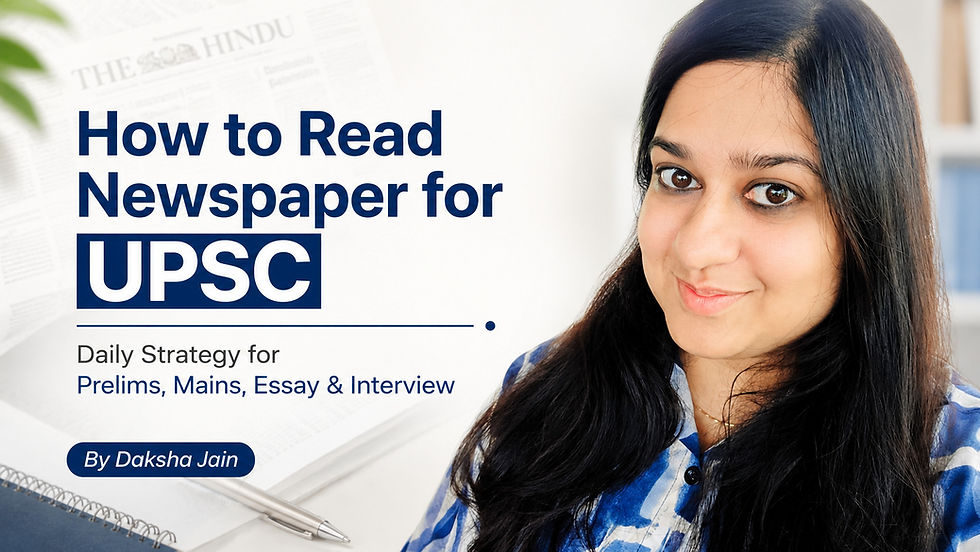
Before sharing this strategy, let me briefly introduce myself. I am Daksha Jain, a UPSC mentor who has qualified 5 UPSC Preliminary Examinations, written 5 UPSC Mains, and appeared in 3 UPSC Personality Tests. Since 2022, I have been mentoring UPSC and State PSC aspirants through personalized one-to-one guidance. This article is based on my own examination experience and years of mentoring serious aspirants. |
Every year, thousands of UPSC aspirants ask the same question:
"How should I read the newspaper for UPSC?"
Some students spend two to three hours reading every page of The Hindu or The Indian Express. Others rely entirely on monthly current affairs magazines or YouTube summaries. Many feel overwhelmed by the sheer volume of news published every day and eventually stop reading newspapers altogether.
After qualifying 5 UPSC Civil Services Preliminary Examinations, writing 5 UPSC Mains, and appearing in 3 UPSC Personality Tests, I have realized one important truth:
Newspaper reading is one of the most misunderstood aspects of UPSC preparation.
The problem is not that aspirants avoid newspapers.
The problem is that most aspirants read newspapers like ordinary readers instead of future civil servants.
Reading every article does not improve your UPSC preparation.
Reading the right articles in the right way does.
During my own preparation, I made this mistake as well. In the beginning, I tried to read almost everything. I believed that missing even a single article might reduce my chances in the examination.
Gradually, I understood that UPSC does not reward information overload.
It rewards analytical thinking.
Once I changed the way I approached newspaper reading, I noticed improvements across every stage of the examination—from Prelims to Mains and finally to the Personality Test.
Today, while mentoring UPSC and State PSC aspirants through one-to-one guidance, newspaper analysis forms one of the most important parts of my mentorship. Rather than asking students to memorize current affairs, I encourage them to understand issues, identify patterns, connect them with the syllabus, and think like future administrators.
That approach consistently produces better results than simply collecting facts.
This guide is based on my own examination experience, years of preparation, and mentoring hundreds of aspirants since 2022.
You Might like this | Complete UPSC Preparation Strategy: Lessons from 5 UPSC Mains & 3 UPSC Personality Tests
Whether you are a beginner starting UPSC preparation, a repeat aspirant, or someone preparing for the Personality Test, this article will help you build a newspaper-reading strategy that is practical, structured, and sustainable.
Why Newspaper Reading Matters for UPSC
One of the biggest misconceptions among beginners is that newspapers are useful only for Current Affairs.
That is only partially true.
A newspaper is much more than a source of daily news.
It is a daily classroom that develops the qualities UPSC expects from a future civil servant.
Unlike school or college examinations, UPSC rarely rewards candidates who simply memorize information.
Instead, it rewards candidates who can:
Understand complex issues
Analyze multiple viewpoints
Think logically
Connect current events with constitutional principles
Suggest practical solutions
Express balanced opinions
These abilities cannot be developed by reading static books alone.
They develop gradually through consistent newspaper reading.
For example, while reading a news report on urban flooding, you are not merely learning about one incident.
You are understanding:
Urban planning
Disaster management
Climate change
Environmental governance
Municipal administration
Public policy
Sustainable development
One article may strengthen multiple subjects simultaneously.
Similarly, a Supreme Court judgment may improve your understanding of:
Indian Polity
Constitutional Law
Governance
Ethics
Essay
Interview discussions
This is why newspaper reading influences almost every stage of the Civil Services Examination.
Newspaper Reading Benefits Every Stage of UPSC
A quality newspaper contributes differently at different stages of the examination.
For UPSC Prelims
Newspapers help you connect static subjects with current developments.
You begin understanding why a particular topic has become important.
Instead of memorizing isolated facts, you understand concepts.
That conceptual clarity improves elimination techniques during the Preliminary Examination.
For UPSC Mains
Mains answers require much more than textbook knowledge.
Examiners expect candidates to provide:
Contemporary examples
Government initiatives
Committee recommendations
Constitutional perspectives
Balanced analysis
Practical solutions
Regular newspaper reading naturally enriches your answers with these dimensions.
For Essay
Essay writing is not about difficult English.
It is about mature thinking.
Daily exposure to social, economic, political, ethical, technological, and environmental issues gradually broadens your perspective.
Over time, you begin seeing connections between different subjects.
That ability is one of the biggest strengths in Essay writing.
For Ethics (GS Paper IV)
Every week newspapers provide real-life examples of:
Integrity
Compassion
Leadership
Accountability
Transparency
Courage
Public Service
Instead of using imaginary examples, you can support your Ethics answers with actual administrative case studies.
Such examples make your answers more authentic and convincing.
For the UPSC Personality Test
By the time you reach the interview stage, newspaper reading becomes invaluable.
The Board is not interested in checking whether you memorized headlines.
Instead, it wants to understand:
How you think
How you analyze issues
Whether your opinions are balanced
Whether you remain calm while discussing complex topics
Candidates who have read newspapers consistently over several years generally perform much better because they understand issues instead of recalling facts.
That confidence cannot be built during the final month before the interview.
Why Most UPSC Aspirants Read Newspapers Incorrectly
One of the biggest reasons students struggle with current affairs is not the newspaper itself.
It is the approach they follow.
Over the years, I have observed the same mistakes repeatedly—not only during my own preparation but also while mentoring aspirants.
Mistake 1: Reading Every Single Page
Many beginners believe that every article is important.
It is not.
Sports news, celebrity interviews, local crime reports, political speeches, entertainment news, and routine government announcements rarely contribute directly to UPSC preparation.
Trying to read everything wastes valuable study time.
A UPSC aspirant should read selectively.
Mistake 2: Memorizing Instead of Understanding
Many students underline every line.
Some make ten pages of notes from a single newspaper.
Later, they never revise those notes.
The objective is not to remember every statistic.
The objective is to understand the issue.
Whenever you read an article, ask yourself:
Why is this issue important?
Which part of the UPSC syllabus does it relate to?
What are the causes?
What challenges exist?
What solutions can be suggested?
These questions are far more valuable than memorizing numbers.
Mistake 3: Reading Without the UPSC Syllabus
The UPSC syllabus should guide your newspaper reading.
Without it, every article appears equally important.
With it, you immediately know whether an issue belongs to:
Polity
Economy
Environment
International Relations
Society
Ethics
Governance
Internal Security
Science & Technology
Your newspaper gradually becomes organized according to the syllabus rather than according to headlines.
Mistake 4: Spending Too Much Time
I often meet aspirants who spend three hours reading newspapers every morning.
This is neither necessary nor sustainable.
For most aspirants, 60–90 minutes of focused newspaper reading is more than sufficient.
The remaining time should be devoted to:
Standard books
Optional subject
Revision
Answer writing
Mock tests
Remember:
Reading newspapers is only one component of UPSC preparation.
It should strengthen your preparation—not replace it.
Mistake 5: Collecting Information Without Revision
Many students prepare beautiful current affairs notebooks.
After a few months, they stop revising them.
Current affairs become useful only when they are revised regularly and connected with static subjects.
Information without revision gradually disappears.
Understanding with revision remains for years.
The Philosophy That Changed My Newspaper Reading
During my UPSC journey, one simple realization transformed the way I read newspapers.
I stopped asking:
"What happened today?"
Instead, I started asking:
"Why does this matter for governance and public administration?"
That single change completely transformed my preparation.
Every article became an opportunity to improve analytical thinking.
Every editorial became an answer-writing exercise.
Every Supreme Court judgment became a Polity revision.
Every environmental issue strengthened Geography and Environment.
Every international development improved International Relations.
Gradually, newspaper reading stopped feeling like a daily task.
It became one of the most enjoyable and rewarding parts of my preparation.
Even today, this remains one of the first habits I encourage every mentee to develop.
Because in my experience, very few habits contribute simultaneously to Prelims, Mains, Essay, Ethics, Optional, and the Personality Test.
Newspaper reading—when done correctly—is one of them.
Which Newspaper Should You Read for UPSC? What to Read, What to Skip & A Step-by-Step Reading Strategy
In the previous section, we discussed why newspaper reading is one of the most valuable habits for every UPSC aspirant and why many students fail to benefit from it despite reading newspapers every day.
The next question naturally is:
"Which newspaper should I read, and how exactly should I read it?"
Every year, thousands of aspirants spend weeks comparing newspapers instead of actually reading one consistently.
Some read The Hindu for a month.
Then someone recommends The Indian Express.
A few weeks later, they shift again because another topper recommends something different.
This cycle continues for months.
Unfortunately, consistency disappears.
During my own UPSC preparation, I realized that the choice of newspaper matters far less than the consistency with which you read it.
A newspaper is a tool.
Your approach determines how useful that tool becomes.
Which Newspaper is Best for UPSC?
This is probably one of the most frequently asked questions by beginners.
My answer has always remained simple.
Choose one quality national newspaper.
Read it consistently.
Do not waste your preparation time comparing newspapers every few months.
Both The Hindu and The Indian Express are excellent newspapers for UPSC preparation.
The important point is not which newspaper you choose.
The important point is whether you understand what you read.
The Hindu
The Hindu has traditionally been one of the most preferred newspapers among UPSC aspirants.
It is known for:
Detailed editorials
Strong coverage of constitutional issues
High-quality international news
Balanced reporting
Excellent analysis of governance and public policy
Students who enjoy detailed reading often find The Hindu extremely useful.
However, beginners sometimes feel that its language is comparatively difficult.
Do not worry.
Within a few months, your reading speed and vocabulary naturally improve.
The Indian Express
The Indian Express is equally valuable for UPSC.
Its strengths include:
Simpler language
Excellent explanations of current issues
Practical governance discussions
Well-written editorials
Strong coverage of economy and policy decisions
Many working professionals prefer Indian Express because its articles are generally shorter and more direct.
Which One Should You Choose?
Students often expect a definite answer.
My recommendation is simple.
Choose the newspaper that you can read consistently every day.
If you already understand The Hindu comfortably, continue reading it.
If you find Indian Express easier to understand, read Indian Express.
Changing newspapers repeatedly does not improve your preparation.
Consistency does.
Do You Need to Read Both Newspapers?
No.
This is another common misconception.
Some aspirants attempt to read:
The Hindu
Indian Express
PIB
PRS
Government websites
Monthly magazines
Coaching current affairs
Every single day.
This creates information overload.
Remember that UPSC is not testing how many newspapers you have read.
It is testing how well you understand important issues.
Reading one newspaper thoroughly is far more beneficial than reading three newspapers superficially.
Which Sections Should You Read Every Day?
This is where most beginners become confused.
Many students begin reading from Page 1 and continue until the last page.
That is not how a UPSC aspirant should approach a newspaper.
Instead, learn to identify the sections that directly contribute to your preparation.
1. National News
This section should always be read carefully.
Focus on:
Constitutional amendments
Supreme Court judgments
High Court judgments of national importance
Parliamentary proceedings
Government policies
New schemes
Governance reforms
Election Commission
CAG
NITI Aayog
Constitutional bodies
Important committees
These topics strengthen:
Polity
Governance
Ethics
Essay
Interview
Whenever you read such news, ask yourself:
Can UPSC frame a question from this issue?
If the answer is yes, spend more time understanding it.
2. Editorial Page
If I had to recommend only one page for UPSC preparation, it would be the Editorial Page.
Many aspirants skip editorials because they feel lengthy.
In reality, editorials develop the most important skill required for UPSC—
Analytical thinking.
Editorials teach you:
How to examine multiple viewpoints
How to develop balanced opinions
How to structure arguments
How to identify challenges
How to suggest solutions
These skills directly improve:
Mains
Essay
Ethics
Personality Test
Do not memorize editorials.
Understand the reasoning behind them.
3. Economy
Read news related to:
RBI
Inflation
GDP
Fiscal policy
Monetary policy
Banking reforms
Employment
Agriculture
Budget
Economic Survey
Government reports
Avoid trying to memorize every economic statistic.
Instead, understand:
Why has this happened?
How does it affect India?
What solutions are being suggested?
UPSC values understanding far more than memorization.
4. International Relations
This section becomes increasingly important after Prelims.
Read news related to:
India's foreign policy
Bilateral relations
International organizations
G20
BRICS
QUAD
SCO
United Nations
Global conflicts
Climate negotiations
While reading International Relations, always connect current developments with static concepts.
5. Science & Technology
Read only important developments.
Examples include:
Space missions
Artificial Intelligence
Biotechnology
Quantum Computing
Semiconductor Mission
Cyber Security
Health innovations
Avoid spending time on every gadget launch or consumer technology update.
6. Environment
Environment has become one of the highest-scoring areas in UPSC.
Read articles related to:
Climate change
Biodiversity
Wildlife
National Parks
Conservation
International conventions
Environmental laws
Pollution
Sustainable development
Always connect environmental news with Geography and Ecology.
What Can You Skip?
One of the biggest productivity improvements comes from knowing what not to read.
Generally, you can safely skip:
Celebrity news
Sports scores
Film reviews
Lifestyle articles
Local crime reports
Political speeches without policy relevance
Advertisements
Entertainment supplements
Horoscope
Stock market fluctuations (unless linked to policy)
Routine party politics
Remember—
UPSC is preparing you to become an administrator.
Read only what contributes to that objective.
A Simple Daily Newspaper Reading Strategy
Over the years, I gradually developed a newspaper reading process that helped me save time while improving understanding.
I now recommend a similar approach to my mentees.
Step 1: Scan the Front Page (5 Minutes)
Do not start reading immediately.
Simply identify:
Which stories are nationally important?
Which are routine news?
Which may relate to the UPSC syllabus?
Select only relevant articles.
Step 2: Read National & Governance News (20 Minutes)
Read carefully.
Do not hurry.
Whenever you encounter an important issue, ask yourself:
Why is this happening?
Which GS paper does it relate to?
What constitutional principle is involved?
This habit develops analytical thinking automatically.
Step 3: Read One Editorial Carefully (20–25 Minutes)
Do not attempt every editorial.
Choose the one with maximum UPSC relevance.
After finishing it, summarize mentally:
Issue
Causes
Challenges
Government initiatives
Way Forward
If you can summarize an editorial in five points, you have understood it.
Step 4: Read Economy, Environment & International News (20 Minutes)
These sections often provide valuable examples for:
Mains
Essay
Interview
Again—
Understand.
Do not memorize.
Step 5: Revise Important Issues (10 Minutes)
Before closing the newspaper, quickly revise:
Major schemes
Important judgments
Committees
Reports
International developments
Daily revision reduces the burden later.
How Much Time Should Newspaper Reading Take?
Many beginners ask me:
"How many hours should I spend on newspapers?"
My recommendation is:
Beginners
60–90 minutes
You need extra time initially because you are learning how to identify relevant articles.
Intermediate Aspirants
45–60 minutes
As your understanding improves, your reading automatically becomes faster.
Experienced Aspirants
30–45 minutes
After years of preparation, you immediately recognize what is important.
You stop reading like a newspaper reader.
You begin reading like an administrator.
My Personal Newspaper Reading Rule
During my preparation, I followed one simple principle.
I never asked:
"Can UPSC ask this article?"
Instead, I asked:
"Can this issue improve my understanding of governance?"
Whenever the answer was yes, I studied it carefully.
Whenever the answer was no, I moved ahead without guilt.
That single habit helped me avoid information overload while continuously improving my analytical thinking.
How Newspaper Reading Helps in Prelims, Mains, Essay & Interview + My Daily Routine
By now, we have discussed:
Why newspaper reading is essential for UPSC
Which newspaper to choose
What to read and what to skip
How to make effective newspaper notes
How to revise current affairs systematically
The final question remains:
How exactly does newspaper reading help you score better in every stage of the UPSC Civil Services Examination?
This is where many aspirants underestimate the true value of newspapers.
They think newspapers are only for Current Affairs.
In reality, newspapers improve almost every paper in the UPSC examination.
Throughout my own preparation, I noticed that students who developed the habit of analytical newspaper reading naturally became better at:
Solving Prelims questions
Writing Mains answers
Writing Essays
Answering Ethics case studies
Performing confidently in the Personality Test
Let us understand why.
Newspaper Strategy for UPSC Prelims
Many beginners assume that reading newspapers means memorizing daily events.
That is not how UPSC asks questions.
UPSC is interested in conceptual understanding.
For example, if there is news about the Ramsar Convention, UPSC may not ask:
"When was this article published?"
Instead, it may ask:
What is the Ramsar Convention?
Why are wetlands important?
Which Indian wetlands have Ramsar status?
How are wetlands linked to biodiversity conservation?
A newspaper introduces the topic.
Your standard books strengthen the concept.
Together, they improve your Prelims preparation.
How Newspapers Improve Elimination Skills
One of the biggest advantages of regular newspaper reading is better elimination.
During my own preparation, I realized that many difficult questions could be eliminated simply because I understood the broader issue.
For example:
If you regularly read about:
Climate negotiations
Financial institutions
Constitutional amendments
International organizations
You automatically develop contextual understanding.
That understanding often helps eliminate incorrect options, even when you are unsure of the exact answer.
This is one reason why experienced aspirants generally perform better in Prelims.
Newspaper Strategy for UPSC Mains
If Prelims rewards conceptual clarity,
Mains rewards analytical thinking.
This is where newspapers become indispensable.
Most UPSC Mains questions require answers that include:
Current examples
Government initiatives
Constitutional principles
Challenges
Balanced arguments
Practical solutions
All these elements develop naturally through consistent newspaper reading.
Example
Suppose UPSC asks:
"Discuss the challenges of urban governance in India."
A candidate who studied only static books may discuss:
Municipal corporations
Constitutional provisions
Urbanization
A candidate who regularly reads newspapers can additionally mention:
Recent Smart Cities initiatives
Urban flooding examples
AMRUT Mission
Waste management challenges
Climate resilience
Technology in urban governance
The second answer is naturally richer, more relevant, and more contemporary.
That is exactly what UPSC expects.
How Newspapers Improve Essay Writing
Many students fear the Essay paper because they think it requires exceptional English.
I disagree.
A good UPSC Essay is built on:
Mature thinking
Logical structure
Balanced viewpoints
Practical examples
Daily newspaper reading develops all four.
Every editorial exposes you to:
Social issues
Economic debates
Governance challenges
Ethical dilemmas
International developments
Technological changes
Gradually, you begin connecting these issues.
That ability helps you write essays that are multidimensional instead of one-dimensional.
Newspapers Provide Ready Examples
Good Essays become memorable because of relevant examples.
Newspapers provide examples related to:
Women empowerment
Artificial Intelligence
Climate change
Public administration
Education reforms
Health policies
Federalism
Cooperative governance
Instead of searching for examples during the examination, you already possess them through months of reading.
Newspaper Strategy for Ethics (GS Paper IV)
Ethics is one of the papers where newspapers provide enormous value.
Definitions can be learned from books.
Application develops through observation.
Every week newspapers publish stories involving:
Honest civil servants
Ethical leadership
Administrative innovation
Transparency
Public accountability
Compassion
Disaster response
Conflict resolution
Whenever you encounter such examples, preserve them.
These real-life case studies strengthen Ethics answers far more than hypothetical examples.
Think Like an Administrator
While reading any governance-related article, ask yourself:
"If I were the District Magistrate, how would I handle this situation?"
This single question develops administrative thinking.
It also improves your approach to Ethics case studies.
UPSC is not looking for emotional reactions.
It expects practical, constitutional, and balanced solutions.
Newspaper Strategy for the UPSC Personality Test
The Personality Test is often misunderstood.
Many aspirants spend the final month memorizing interview questions.
That approach rarely works.
The Interview Board evaluates:
Awareness
Judgment
Communication
Emotional maturity
Balance
Administrative aptitude
These qualities cannot be developed overnight.
They evolve gradually through years of reading, reflection, and discussion.
Editorials Prepare You for Discussions
Editorials teach you something extremely valuable.
They show you how intelligent people disagree respectfully.
Instead of presenting extreme opinions, they discuss:
Advantages
Limitations
Constitutional perspectives
Economic implications
Social consequences
This balanced thinking becomes extremely useful during the Personality Test.
Whenever the Board asks:
"What is your opinion on this issue?"
You naturally present a balanced response instead of an emotional one.
My Daily Newspaper Routine During UPSC Preparation
Students frequently ask:
"What was your own newspaper routine?"
Although every aspirant should design a routine according to individual circumstances, my daily process gradually became very simple.
Morning
Read one quality newspaper.
Focus only on UPSC-relevant articles.
During Reading
Ask:
Why is this important?
Which GS paper does it relate to?
Can it become a Mains question?
After Reading
Write short notes only if necessary.
Not every article deserves notes.
Evening
Revise important issues.
Connect them with static subjects.
If possible, write one short answer based on one newspaper issue.
That single exercise improved my answer writing significantly over time.
How I Guide Aspirants in Newspaper Reading Over the last several years, I have noticed that many UPSC aspirants struggle with newspaper reading—not because newspapers are difficult, but because they are unsure what to read, what to skip, and how to connect daily news with the UPSC syllabus. During my one-to-one mentorship sessions, newspaper analysis forms an important part of our discussions. Rather than asking students to memorize current affairs, I help them understand how each important issue can be used in Prelims, Mains, Essay, Ethics, and the Personality Test. Every student has different strengths and challenges. Some struggle with answer writing, others with current affairs or revision. Therefore, my guidance is always personalized according to the student's preparation stage and individual requirements. My objective is simple—to help serious aspirants develop analytical thinking instead of merely collecting information. |
My Advice to Beginners
If you are starting UPSC preparation today,
Do not worry about reading newspapers perfectly.
Nobody reads newspapers perfectly in the beginning.
Initially, focus on consistency.
After a few months,
Your reading speed improves.
Your understanding improves.
Your note-making improves.
Your analytical thinking improves.
Eventually, newspaper reading becomes one of the easiest parts of your preparation.
Trust the process.
Common Newspaper Reading Mistakes to Avoid
Over the years, I have repeatedly observed these mistakes among aspirants.
Avoid them from the beginning.
Reading newspapers only before the examination.
Current Affairs cannot be covered in one month.
Reading newspapers without the UPSC syllabus.
Always connect articles with the syllabus.
Reading multiple newspapers every day.
One quality newspaper is enough.
Memorizing instead of understanding.
Develop concepts.
Not facts.
Making excessively long notes.
Keep notes short and revision-friendly.
Ignoring editorials.
Editorials improve analytical thinking more than almost any other newspaper section.
Never revising current affairs.
Revision transforms information into usable knowledge.
Reading newspapers but never writing answers.
Knowledge improves only when applied.
Practice answer writing regularly.
My Final Advice to Every UPSC Aspirant
After qualifying five UPSC Preliminary Examinations, writing five UPSC Mains, appearing in three UPSC Personality Tests, and mentoring aspirants since 2022, one lesson has remained constant.
Newspaper reading is not about collecting information.
It is about developing the mindset of a future civil servant.
Every important article teaches you to:
Think objectively.
Analyze multiple perspectives.
Understand governance.
Respect constitutional values.
Suggest practical solutions.
These qualities are exactly what UPSC seeks.
The newspaper is not just a source of Current Affairs.
It is a daily exercise in becoming a better administrator.
Read it consistently.
Read it analytically.
Read it with purpose.
Over time, you will notice improvements not only in your Prelims score but also in your Mains answers, Essays, Ethics, Personality Test, and overall understanding of India and the world.
That transformation does not happen in a week.
It happens through small, disciplined efforts repeated every day.
And in my experience, those ordinary daily efforts often produce extraordinary UPSC results.
Looking for Personalized UPSC Guidance? If you are preparing for the UPSC Civil Services Examination or any State PSC examination and would like structured one-to-one guidance, you are welcome to connect with me. Contact Details: Daksha Jain 📞 Phone: +91-8858804476 ▶️ YouTube: UPSC CSE with Daksha |
Frequently Asked Questions (FAQs)
Q. How much time should I spend reading the newspaper for UPSC?
Most aspirants can complete newspaper reading in 45–90 minutes. Beginners may initially take longer, but the time reduces as they become familiar with identifying UPSC-relevant articles.
Q. Which newspaper is better for UPSC: The Hindu or Indian Express?
Both newspapers are excellent. Choose one and read it consistently rather than switching between multiple newspapers.
Q. Should I make newspaper notes every day?
Yes, but keep them short and revision-oriented. Focus on important issues, government initiatives, challenges, and way forward instead of copying complete articles.
Q. Is newspaper reading enough for Current Affairs?
No. Newspapers should be combined with standard books, previous year questions, revision, and answer writing practice for comprehensive preparation.
Q. Can I skip newspapers and rely on monthly current affairs magazines?
Monthly magazines are useful for revision, but they cannot replace newspapers because newspapers help develop analytical thinking, which is essential for Mains, Essay, Ethics, and the Personality Test.
About the Author Daksha Jain is a UPSC mentor with firsthand experience of qualifying 5 UPSC Civil Services Preliminary Examinations, writing 5 UPSC Mains, and appearing in 3 UPSC Personality Tests. Since 2022, she has been mentoring UPSC and State PSC aspirants through personalized one-to-one guidance. Her mentorship focuses on helping students build a structured preparation strategy through newspaper analysis, answer writing, revision planning, current affairs, PSIR Optional guidance, and interview preparation. She also shares practical UPSC preparation strategies through her educational YouTube channel, UPSC CSE with Daksha, with the aim of making reliable and experience-based guidance accessible to serious aspirants. |

Comments