Union Budget 2026 Presented on a Sunday: A First in Independent India

Updated: Feb 1
In 1999, when February 28 fell on a Sunday, then Finance Minister Yashwant Sinha presented the Budget a day earlier on Saturday, February 27, during the Atal Bihari Vajpayee–led NDA government.
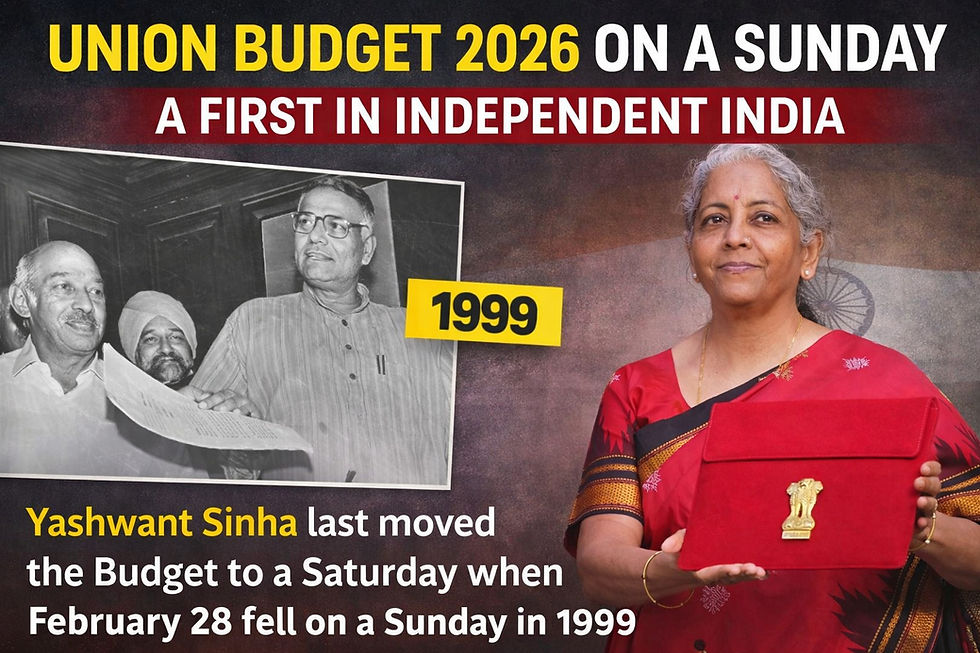
Nirmala Sitharaman Creates History With 9th Consecutive Union Budget
Union Finance Minister Nirmala Sitharaman created history on February 1 by presenting her ninth consecutive Union Budget, becoming the first Finance Minister in India to deliver nine Budgets in an unbroken sequence.
With the presentation of the Union Budget 2026–27, Sitharaman has surpassed former Finance Ministers P. Chidambaram and Pranab Mukherjee, securing her position as the second-highest budget presenter in India’s fiscal history. She has held the Finance Ministry continuously since 2019 under Prime Minister Narendra Modi, maintaining a steady and uninterrupted run.
How Sitharaman’s Budget Record Compares With Past Finance Ministers
With nine consecutive Budgets, Sitharaman now stands just one step behind Morarji Desai, the former Prime Minister and Finance Minister who holds the all-time record of 10 Union Budgets.
Budget Presentation Records in India
Morarji Desai: 10 Budgets (1958–63 and 1967–69; not consecutive)
Nirmala Sitharaman: 9 Budgets (2019–2026; all consecutive)
P. Chidambaram: 9 Budgets across three decades
Pranab Mukherjee: 8 Budgets
If Sitharaman presents the Union Budget in 2027, she will tie Morarji Desai’s record, while retaining the distinction of the longest uninterrupted streak in Indian history.
Union Budget 2026 Presented on a Sunday: Why This Is Historic
For the first time since Independence, the Union Budget has been presented on a Sunday. Nirmala Sitharaman delivered the Budget speech in the Lok Sabha at 11 am on February 1, breaking a long-standing tradition where governments avoided Sundays for major parliamentary business.
While India has seen Budgets presented on Saturdays in 2015, 2020, and 2025, a Sunday Budget has never occurred before, making Budget 2026 a historic first.
Why Governments Earlier Avoided Sunday Budgets
Traditionally, if February 1 or February 28 fell on a weekend, governments adjusted the Budget date to ensure it was presented on a working day.
The 1999 Precedent
In 1999, when February 28 fell on a Sunday, then Finance Minister Yashwant Sinha presented the Union Budget a day earlier on Saturday, February 27, during the Atal Bihari Vajpayee–led NDA government. The prevailing belief was that important parliamentary business should take place on working days.
That approach remained the norm for decades.
The Budget That Changed the Clock: Why 11 am Matters
The 1999 Budget is remembered not just for its timing on a Saturday, but for ending a colonial-era practice. Until then, India presented its Budget at 5 pm, a legacy of British rule designed to align announcements with working hours in London.
Yashwant Sinha shifted the presentation to 11 am, asserting India’s independent priorities. That timing has since become the standard and continues with Budget 2026.
Why February 1 Can No Longer Be Shifted
A major reform in 2017 permanently fixed February 1 as the date for presenting the Union Budget.
Reason for the Change
To give Parliament adequate time to debate and approve proposals
To allow ministries and state governments to implement allocations
To ensure smooth execution before the new financial year begins on April 1
Because of this reform, February 1, 2026 could not be moved, even though it fell on a Sunday—making the Sunday Budget unavoidable.
What Happens When the Budget Is Presented on a Sunday
Despite being a holiday, constitutional and financial processes continue as usual.
Key Implications
Parliament sits as scheduled, and the Finance Minister delivers the Budget speech in the Lok Sabha
BSE and NSE, normally closed on Sundays, are holding special full trading sessions
Investors and analysts get extra time to study tax proposals and fiscal targets
Market volatility remains possible, especially when regular trading resumes if there are surprises
Economic Context Ahead of Union Budget 2026–27
The Budget is being presented amid global economic uncertainty, including trade tensions and concerns over U.S. tariffs and their impact on Indian exports.
According to the Economic Survey 2025–26, tabled on January 29, India’s economy is projected to grow between 6.8% and 7.2% in the upcoming fiscal year.
Read Also | Budget Session 2026: Structure and Timeline
Tax Reforms and Middle-Class Expectations
One of the biggest focus areas is the transition to the New Income Tax Act, 2025, which will replace the Income Tax Act of 1961 from April 1, 2026.
What Taxpayers Are Watching
A higher standard deduction for salaried employees
Possible expansion of the Section 87A rebate
Simplification under the new tax regime
Middle-class taxpayers and salaried employees are closely tracking these announcements.
Likely Big-Ticket Allocations in Budget 2026
Major allocations are expected for:
Infrastructure and Capital Expenditure (CapEx)
Railways, including rollout of Kavach 4.0 safety systems
Defence
Artificial Intelligence (AI) and emerging technologies
These sectors are seen as critical for long-term growth and strategic resilience.
Why Budget 2026 Matters Beyond the Numbers
Nirmala Sitharaman’s ninth consecutive Budget is significant not just for fiscal proposals, but for what it represents:
Policy continuity
Institutional stability
Breaking long-standing administrative traditions
Steering reforms amid global uncertainty
By presenting the Budget on a Sunday and maintaining an unbroken streak since 2019, Sitharaman has redefined modern fiscal continuity in India.
The Bigger Picture
Union Budget 2026–27 stands out as:
A record-breaking moment in India’s fiscal history
A turning point in Budget traditions
A crucial roadmap ahead of the new tax regime
Whether remembered for tax relief, spending priorities, or historic firsts, Budget 2026 has already secured its place in India’s economic narrative.
Union Budget 2026 FAQs
Q. Why was the Union Budget 2026 presented on a Sunday?
Ans. The Union Budget 2026 was presented on a Sunday because February 1 has been fixed as the permanent Budget date since 2017. As February 1, 2026 fell on a Sunday, the government retained the date to ensure sufficient time for parliamentary debate and implementation before the new financial year begins on April 1.
Q. Has the Union Budget ever been presented on a Sunday before?
Ans. No, the Union Budget has never been presented on a Sunday before in independent India. While Budgets have been presented on Saturdays in the past, including in 2015, 2020 and 2025, Budget 2026 marks the first-ever Sunday presentation.
Q. What happened in 1999 when the Budget date fell on a Sunday?
Ans. In 1999, when February 28 fell on a Sunday, then Finance Minister Yashwant Sinha presented the Union Budget a day earlier on Saturday, February 27, under the Atal Bihari Vajpayee–led NDA government. At the time, governments avoided presenting the Budget on holidays.
Q. Why can’t the Union Budget date be changed anymore?
Ans. Since 2017, February 1 has been fixed as the permanent date for the Union Budget. The reform was introduced to give Parliament, ministries, and state governments adequate time to debate, approve, and implement Budget proposals before the financial year starts on April 1.
Q. What time is the Union Budget presented and why?
Ans. The Union Budget is presented at 11 am in the Lok Sabha. This timing was introduced in 1999 by Finance Minister Yashwant Sinha, replacing the earlier 5 pm presentation time that followed a colonial-era practice aligned with London’s working hours.
Q. Are stock markets open when the Budget is presented on a Sunday?
Ans. Normally, stock markets remain closed on Sundays. However, for Union Budget 2026, both the BSE and NSE are holding special full trading sessions to allow investors to react immediately to Budget announcements.
Q. How many consecutive Budgets has Nirmala Sitharaman presented?
Ans. Nirmala Sitharaman has presented nine consecutive Union Budgets from 2019 to 2026. She is the first Finance Minister in India to deliver nine Budgets in an unbroken sequence, creating a new record in India’s fiscal history.
Q. Who holds the record for presenting the most Union Budgets in India?
Ans. Former Prime Minister and Finance Minister Morarji Desai holds the record for presenting the most Union Budgets, with a total of 10. However, his Budgets were not presented consecutively, unlike Nirmala Sitharaman’s nine consecutive Budgets.
Q. What are the key expectations from Union Budget 2026–27?
Ans. Union Budget 2026–27 is expected to focus on the transition to the New Income Tax Act, 2025, infrastructure and capital expenditure, railways including Kavach 4.0, defence, artificial intelligence, and measures to support economic growth amid global trade uncertainties.
Q. Why is Union Budget 2026 considered historically significant?
Ans. Union Budget 2026 is historically significant because it is the first Budget presented on a Sunday, marks Nirmala Sitharaman’s ninth consecutive Budget, and is being delivered amid major tax reforms and global economic uncertainty.


Comments