Daily Current Affairs - 12th November 2025

Updated: Nov 21, 2025
Comprehensive UPSC Current Affairs Summary | Ethiopia COP32, Bhutan Visit, Climate Reports, TB Vaccine, Booker Prize 2025

If you missed Monthly Current Affairs Pointers (CAP) | Sept - Oct 2025, read it here.
Ethiopia and COP32 |
Ethiopia, whose capital is Addis Ababa, has been selected to host the UNFCCC COP32 in 2027.
The decision to host COP32 was announced during COP30 in Belem, Brazil.
Ethiopia was chosen by the African group of countries over its rival Nigeria, which also bid to host the event.
The country will organize COP32 in Addis Ababa.
The host for COP31 next year (2026) is still undecided, with Australia and Türkiye actively competing.
COP meetings are held by rotation among five UN-designated geographical regions: Africa, Asia-Pacific, Eastern Europe, Latin America & Caribbean, and Western Europe & Others.
The decision for the next host country must be made by the end of COP30 to allow enough preparation time.
India has expressed its intention to host COP33 in 2028, when the conference returns to the Asia region.
Prime Minister Narendra Modi announced India’s bid during the COP28 Dubai conference in 2023.
If India hosts COP33, it would be the second time India hosts a COP, the first being COP8 in 2002.
Earlier COPs like COP8 were smaller events, held before COPs became high-profile conferences attracting hundreds of heads of state.
Political Features of Ethiopia

Ethiopia is a landlocked country in the Horn of Africa, meaning it has no direct access to the sea.
Ethiopia lost access to the sea after Eritrea’s secession in 1993.
The country lies entirely within tropical latitudes, giving it a generally warm climate.
Ethiopia shares borders with Eritrea (North), Djibouti (Northeast), Somalia (East), Kenya (South), and South Sudan and Sudan (West).
Geographic Features of Ethiopia
Major rivers in Ethiopia include the Blue Nile, Tekeze, Baro, Shebele, Genale, Awash, and Omo River.
Ethiopia is part of the East African Rift System, which is a tectonic rift valley system formed by the splitting of the African Plate.
The Kobar Sink in the Danakil Plain drops as low as 116 metres (380 feet) below sea level, making it one of the lowest points in Africa.
The highest point in Ethiopia is Mount Ras Dejen, a peak in the Simien Mountains.
K4: Old friend of India, Bhutan’s guiding hand |
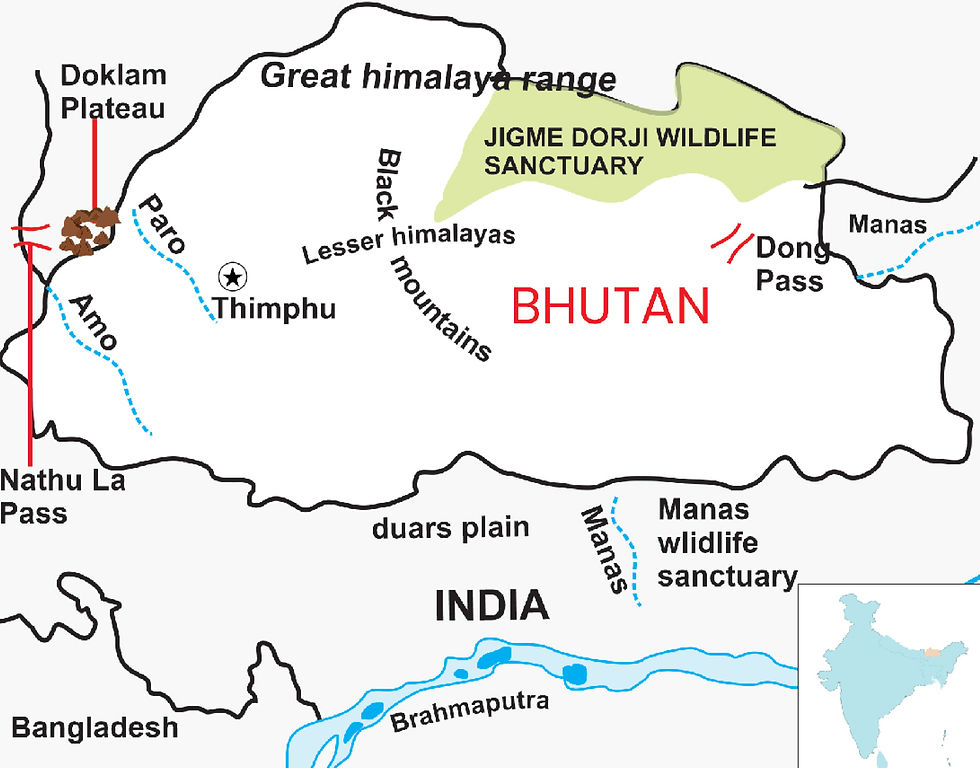
Prime Minister Narendra Modi visited Bhutan to attend the 70th birthday celebrations of the fourth king, Jigme Singye Wangchuck.
Jigme Singye Wangchuck, popularly known as K4, is the father of the current king, Jigme Khesar Namgyel Wangchuck.
During the visit, Modi held talks with the incumbent king Jigme Khesar Namgyel Wangchuck.
Modi and the Bhutanese king inaugurated the 1,020 megawatt Punatsangchhu-II hydroelectric project, developed jointly by India and Bhutan.
The two leaders discussed cooperation in sectors like energy, capacity building, connectivity, technology, defence, and security.
They agreed on an understanding to resume work on the main dam structure of the 1,200 MW Punatsangchhu-I Hydroelectric Project.
A decision was made to grant land in Varanasi, India, for a Bhutanese temple/monastery and a guest house.
They also decided to establish an immigration check post in Hatisar (India) across Gelephu (Bhutan).
A Rs 4,000-crore Line of Credit (LoC) from India to Bhutan was agreed upon to support development projects.
Modi emphasized that India-Bhutan partnership is a key pillar of India’s Neighbourhood First Policy.
About K4 – Jigme Singye Wangchuck
Jigme Singye Wangchuck, or K4, became King of Bhutan (Druk Gyalpo, meaning Dragon King in Dzongkha language) in 1972 at the age of 16.
He ascended the throne after the death of his father, King Jigme Dorji Wangchuck.14. During his over 30-year reign, K4 interacted with 12 Indian Prime Ministers, from Indira Gandhi to Manmohan Singh.
He abdicated the throne in 2006 in favor of his son and initiated the transition from a hereditary monarchy to a constitutional monarchy, leading Bhutan to democracy in 2008.
Before becoming king, K4 was appointed Chairman of Bhutan’s Planning Commission in 1971, coordinating the country’s five-year plans, which were modelled on India’s Five-Year Plans.
These plans, launched with help from Prime Minister Jawaharlal Nehru in 1961, gave K4 early exposure to governance.
This role familiarized him with Indian financial support and hydro-power discussions, while helping him build rapport with Indira Gandhi.
In 1974, he pegged the Bhutanese currency (Ngultrum) to the Indian rupee at 1:1, minimizing foreign exchange risks and facilitating trade with India.
K4 made early decisions to strengthen Bhutan-India ties by maintaining close contact with leaders in Assam, West Bengal, Odisha, and senior officials in Delhi.
Diplomatic and International Engagements
Bhutan became a member of the United Nations in 1971 under K4’s reign.
K4 established diplomatic ties with Bangladesh (1973), Kuwait and Nepal (1983), Maldives (1984), Denmark, Norway, Sweden, Switzerland, Netherlands (1985), Japan and Finland (1986), South Korea and Sri Lanka (1987), Austria (1989), Thailand (1991), Bahrain (1992), Singapore and Australia (2002), and Canada (2003).
He coordinated with Rajiv Gandhi during the establishment of SAARC (South Asian Association for Regional Cooperation) and attended the 1985 Dhaka meeting as one of its founding members.
Under K4, hydro-power cooperation with India expanded significantly, benefiting both countries.
He also led security cooperation with India to remove militants from Bhutanese territory in 2003–04, when Atal Bihari Vajpayee was India’s Prime Minister.
India-Bhutan Friendship Treaty and Modernization
While abdicating in 2006, K4 negotiated with Manmohan Singh on the India-Bhutan Friendship Treaty of 2007.
The 2007 treaty upgraded the 1949 India-Bhutan Treaty, reflecting modern realities and replacing the clause that Bhutan would be guided by India in external affairs.
This established a mutual-cooperation framework, aligning with Bhutan’s democratic transition and reinforcing partnership with India.
‘Global Cooling Watch 2025’ Report – UNEP Cool Coalition |
The ‘Global Cooling Watch 2025’ Report, published by the UN Environment Programme (UNEP) through its Cool Coalition, calls for an urgent global shift to Sustainable Cooling.
The Report outlines a Sustainable Cooling Pathway, aimed at dramatically reducing projected greenhouse gas (GHG) emissions from the cooling sector by 2050.
Key Concerns Raised in the Report
Under a Business-as-Usual (BAU) Cooling Pathway, the global stock of cooling equipment is projected to more than triple by 2050, rising from 22 terawatts (TW) in 2022 to 68 TW.
The term Business-as-Usual (BAU) refers to a scenario with no major policy or technological interventions beyond current trends.
The Report highlights significant policy gaps, noting that only 54 nations currently meet full Sustainable Cooling Pathway standards, despite broad policy inclusion worldwide.
Escalating extreme heat is another major concern, as the global population exposed to deadly heat stress could rise from 30% today to between 48% and 76% by the end of this century, according to the IPCC (Intergovernmental Panel on Climate Change).
This heat stress risk is further amplified by the Urban Heat Island (UHI) effect, where cities experience higher temperatures due to dense infrastructure and reduced vegetation.
Increasing frequency and intensity of heatwaves further worsen this vulnerability and energy demand for cooling.
Proposed Sustainable Cooling Pathway
The first pillar is Passive Cooling, which aims to reduce cooling loads through passive building design, urban planning, and simple interventions like installing doors on refrigerated cabinets to save energy and lower emissions.
The second pillar is Low-Energy Cooling, focusing on energy-efficient alternatives such as fans and evaporative coolers instead of or in combination with traditional air conditioning systems to cut energy use and costs.
The third pillar is Best Energy Efficiency, emphasizing high-efficiency cooling systems equipped with variable-speed compressors and maintained properly to ensure optimal performance and lower energy consumption.
The fourth pillar is the Rapid HFC Phase-Down, which promotes the use of low-GWP (Global Warming Potential) refrigerants that maintain efficiency while reducing direct emissions from cooling equipment.
HFCs (Hydrofluorocarbons) are synthetic refrigerants with very high global warming potential, and phasing them down is essential for sustainable cooling and climate goals.
Beat the Heat Global Initiative
The Beat the Heat Global Initiative is a joint effort by UNEP’s Cool Coalition and Brazil (COP30 Presidency) to translate the Global Cooling Watch findings into real-world climate action.
The main objective of this initiative is to promote multi-level governance, engaging governments, cities, industries, and financial institutions to ensure equitable access to sustainable cooling.
The initiative focuses on integrating passive and nature-based cooling designs, which leverage natural ventilation, shading, and green infrastructure to reduce urban temperatures.
It also encourages public procurement of energy-efficient and low-GWP cooling technologies, driving large-scale market transformation.
Additionally, it supports urban heat planning, aiming for inclusive cooling solutions that protect vulnerable communities from extreme heat impacts.
State of the Cryosphere Report 2025 – Key Highlights (by International Cryosphere Climate Initiative) |
The cryosphere refers to all frozen water parts of the Earth, including ice sheets, mountain glaciers, snow, sea ice, permafrost, and polar oceans.
The 2025 report highlights rapid and alarming changes across five major cryosphere components – Ice Sheets, Polar Oceans, Mountain Glaciers and Snow, Sea Ice, and Permafrost.
1. Ice Sheets
Ice sheets, which are massive continental-scale ice masses covering Greenland and Antarctica, are losing ice at an accelerating rate.
The losses from the Greenland and Antarctic ice sheets have quadrupled since the 1990s, indicating a drastic increase in melt rate.
This large-scale ice loss directly contributes to sea-level rise, which causes widespread loss of coastal infrastructure, agricultural land, homes, and livelihoods.
2. Polar Oceans
Polar oceans, located around the Arctic and Antarctic, play a vital role in absorbing heat and carbon dioxide (CO₂) from the atmosphere.
Rising greenhouse gas concentrations are reducing the capacity of these oceans to function as global heat and carbon absorbers.
The report notes that two major ocean current systems—the Antarctic Overturning Circulation (AOC) and the Atlantic Meridional Overturning Circulation (AMOC)—have slowed substantially due to freshwater melt from ice sheets and glaciers.
This slowdown in ocean circulation weakens global climate regulation, affecting weather systems and marine ecosystems worldwide.
3. Mountain Glaciers and Snow
Mountain glaciers, which store freshwater in frozen form, are retreating rapidly due to rising global temperatures.
Between 2000 and 2023, the world lost 273 gigatons of glacier ice per year, showing an exponential increase in glacier melt.
This accelerating glacier loss threatens water, food, economic, and political security for billions of people who depend on glacier-fed rivers.
4. Sea Ice
Sea ice, which forms and floats on the surface of polar oceans, has seen a dramatic decline in both extent and thickness.
Since 1979, sea ice at both poles has declined by 40–60%, marking a major transformation in the polar environment.
The loss of sea ice amplifies warming in the Arctic, a process known as Arctic amplification, which increases regional and global temperature rise.
This decline also threatens ice-dependent species, disrupts weather patterns and ocean currents, and intensifies sea-level rise risks.
5. Permafrost
Permafrost refers to permanently frozen ground found in high-latitude and high-altitude regions.
Over 210,000 km² of permafrost has thawed per decade since the onset of current global warming trends.
Thawing permafrost releases vast quantities of ancient organic carbon, which is three times more than the carbon currently present in the atmosphere.
This process significantly reduces the global carbon budget, making climate stabilization targets much harder to achieve.
India’s First MWh-Scale Vanadium Redox Flow Battery (VRFB) at NTPC NETRA |
India has inaugurated its largest and first megawatt-hour (MWh)-scale Vanadium Redox Flow Battery (VRFB) at NTPC NETRA (NTPC Energy Technology Research Alliance).
This marks a significant step in advancing next-generation battery technologies for clean and large-scale energy storage in India.
Flow Batteries, along with Solid-State Batteries, represent next-generation battery systems designed to overcome the limitations of traditional lithium-ion batteries.
About Flow Batteries
A Flow Battery operates on reduction-oxidation (redox) reactions, where chemical energy is converted into electrical energy through electron transfer.
It uses two different liquid electrolytes—chemical solutions that conduct electricity—which flow through a porous membrane allowing ions or protons to move between them.
The energy storage capacity of a flow battery depends on the size of the electrolyte tanks, meaning more liquid = more energy stored.
Flow batteries are non-flammable, use non-polluting materials, and therefore offer high safety and environmental advantages over lithium-ion batteries.
The main types of flow batteries include Vanadium Redox, Zinc–Bromine, and Iron–Salt or Organic systems.
A Vanadium Redox Flow Battery (VRFB) specifically uses different oxidation states of vanadium ions in both electrolytes, ensuring long life, high efficiency, and easy scalability.
About Solid-State Batteries
Solid-State Batteries replace the liquid electrolyte with a solid electrolyte, which conducts ions through solid material instead of a liquid.
They do not require a separate separator, unlike conventional batteries, simplifying design and enhancing performance.
These batteries are safer and more stable, as the solid electrolyte is less prone to leakage, damage, or swelling under high temperatures.
Significance of Next-Generation Battery Technologies
Both flow and solid-state batteries are highly suitable for grid-scale energy storage, as they allow independent scaling of power and energy capacity.
This means power output (in MW) and energy storage (in MWh) can be scaled separately, offering flexibility for renewable energy integration.
They provide a sustainable alternative to lithium-ion batteries, thereby diversifying material dependency and improving supply chain security.
These technologies are increasingly used in power management systems, pumping stations, and large-scale grid energy storage facilities.
They enable Long-Duration Energy Storage (LDES)—the ability to store energy for extended periods—and support grid stability during renewable fluctuations.
By enhancing renewable energy integration, such batteries strengthen energy security and grid resilience for a low-carbon future.
National One Health Mission |
The Union Government is set to launch the National One Health Mission to strengthen India’s health security and pandemic preparedness.
The mission has been approved by the Prime Minister’s Science, Technology, and Innovation Advisory Council (PM-STIAC).
It aims to establish a robust, integrated system for disease control and pandemic preparedness across human, animal, and environmental health sectors.
The mission recognizes that human health, animal health, and environmental health are deeply interconnected, a concept known as the One Health approach.
Vision and Objectives
The vision of the National One Health Mission is to build an integrated disease control and pandemic preparedness system in India.
It seeks to bring together human, animal, and environmental sectors to achieve better health outcomes, higher productivity, and biodiversity conservation.
This integration will help India prevent, detect, and respond to emerging health threats more efficiently.
Institutional Framework
The Indian Council of Medical Research (ICMR) will serve as the implementing agency for the mission.
The National Institute of One Health, Nagpur will function as the anchor institution, coordinating research, data, and policy implementation.
Critical Pillars of the Mission
The mission is built on four critical pillars –
Research & Development,
Clinical Readiness,
Data Integration, and
Community Engagement.
1. Research and Development (R&D)
This pillar focuses on driving targeted research and innovation to address zoonotic and emerging diseases.
It aims to develop essential health tools such as vaccines, diagnostics, and therapeutics for rapid response and control.
2. Clinical Readiness
The clinical readiness component works on enhancing healthcare infrastructure and response capacity.
It ensures that hospitals and laboratories are prepared to manage outbreaks and pandemics effectively.
3. Data Integration
This pillar emphasizes streamlining data linkages across the human, animal, and environmental sectors.
Integrated data systems will enable better information sharing, access, and analytics to detect and track disease patterns early.
4. Community Engagement
The community engagement pillar focuses on involving local communities in disease awareness, reporting, and response actions.
It ensures a constant state of preparedness by promoting public participation and behavioral awareness.
About the ‘One Health’ Concept
The ‘One Health’ approach is an integrated and unifying framework that aims to sustainably balance and optimize the health of people, animals, and ecosystems.
It recognizes that human health depends on the health of animals and the environment, especially in an era of emerging infectious diseases.
Relevance of One Health in India
India’s unique demographics make the One Health approach crucial, as the country has diverse wildlife, one of the world’s largest livestock populations, and a dense human population.
The country has faced multiple disease outbreaks, such as the COVID-19 pandemic, Lumpy Skin Disease in cattle, and recurring Avian Influenza (bird flu) events.
These challenges highlight the urgent need for a coordinated, multi-sectoral health system under the National One Health Mission.
CAQM Invokes Stage-III of GRAP in NCR amid Severe Air Pollution |
The Commission for Air Quality Management (CAQM) has invoked Stage-III of the Graded Response Action Plan (GRAP) in the National Capital Region (NCR) due to rising air pollution levels.
The decision was taken after Delhi’s Air Quality Index (AQI) entered the ‘Severe’ category, reflecting extremely high concentrations of pollutants.
AQI or Air Quality Index is a standardized scale that indicates overall air pollution levels on a numerical scale ranging from 0 to 500.
About the Commission for Air Quality Management (CAQM)
The CAQM is a statutory body established under the Commission for Air Quality Management in National Capital Region and Adjoining Areas Act, 2021.
It serves as the central authority for coordinating and implementing policies to improve air quality across Delhi-NCR and adjoining states.
About the Graded Response Action Plan (GRAP)
The Graded Response Action Plan (GRAP) is an emergency response mechanism designed for the entire NCR to combat episodes of deteriorating air quality.
GRAP is triggered based on Delhi’s average AQI levels, ensuring a coordinated response among multiple agencies.
The plan defines specific measures to be taken at different stages of pollution severity, divided into four categories.
Stages of GRAP
Stage-I: Poor Category is activated when the AQI is between 201 and 300.
Stage-II: Very Poor Category is triggered when AQI ranges between 301 and 400.
Stage-III: Severe Category is implemented when AQI is between 401 and 450.
Stage-IV: Severe Plus Category comes into effect when AQI exceeds 451.
Measures under Stage-III (Severe Category)
Under Stage-III, CAQM enforces a 9-point action plan to reduce emissions and control pollution sources.
This includes a ban on construction and mining activities, which are major sources of dust and particulate pollution.
It also includes restrictions on polluting vehicles, particularly older diesel trucks and heavy-duty vehicles.
Hybrid schooling (mix of online and offline classes) is encouraged to reduce school-related vehicular traffic.
Staggered office timings and work-from-home options are promoted to minimize traffic congestion and vehicular emissions.
Reasons for NCR’s Persistent Air Pollution
The topographical factors of the NCR region contribute significantly to pollution accumulation.
The Indo-Gangetic plain acts as a basin, trapping pollutants due to its geographical depression.
Natural barriers like the Himalayas in the north and the Aravalli hills in the southwest restrict wind flow, preventing pollutant dispersion.
Meteorological factors such as temperature inversion—a condition where warm air traps pollutants near the ground—further worsen air quality.
Low wind speeds during winter reduce the natural dispersion of suspended particles.
Anthropogenic pollution sources—including stubble burning, vehicular exhaust, and industrial emissions—add large volumes of fine particulate matter (PM2.5 and PM10) into the atmosphere.
Case Study: Beijing’s Air Pollution Control Strategy
Beijing’s experience offers valuable insights into tackling severe urban air pollution through consistent and coordinated action.
The city’s average AQI improved significantly, dropping from 144 in 2015 to 92 in 2024.
Beijing implemented a phased, long-term strategy between 1998 and 2017, emphasizing local governance, public participation, and strong regulation.
The three-phase anti-pollution plan targeted emission reductions from key sectors like coal power, transport, and construction industries.
The strategy included a shift towards clean energy, vehicle upgrades, and stricter industrial emission rules.
Regional cooperation was fostered with five surrounding provinces to manage transboundary pollution effectively.
Significant public investment in clean technologies and pollution control infrastructure led to a sharp and sustained reduction in pollutant levels.
Booker Prize 2025 |
David Szalay has won the 2025 Booker Prize for his novel Flesh.
Flesh marks his sixth work of fiction, showcasing his continued literary excellence.
With this achievement, he became the first Hungarian-British author to win the prestigious Booker Prize.
The Booker Prize, established in 1969 in the United Kingdom (UK), is one of the world’s most prestigious literary awards.
The primary aim of the Booker Prize is to honor the best English-language fiction published in the UK or Ireland each year.
The winner of the Booker Prize receives a cash award of £50,000, recognizing outstanding literary merit.
Each shortlisted author also receives £2,500, acknowledging their exceptional contributions to literature.
The Booker Prize should not be confused with the International Booker Prize, which is a separate award.
The International Booker Prize celebrates the best works of long-form fiction or collections of short stories that are translated into English.
These translated works must also be published in the UK and/or Ireland to qualify for the International Booker Prize.
(Note: “Fiction” refers to imaginative or invented literature, and “long-form fiction” typically means novels or novellas.)
Altermagnetism |
Altermagnetism has emerged as a new class of magnetic order in condensed matter physics.
It uniquely combines properties of both ferromagnetism and antiferromagnetism, making it a distinct magnetic phenomenon.
In ferromagnetism, all tiny atomic magnets (called magnetic moments or spins) align in the same direction.
This alignment in ferromagnets creates a strong external magnetic field, as seen in common fridge magnets.
In contrast, antiferromagnets have atoms whose magnetic directions alternate, pointing in opposite directions.
This alternating pattern in antiferromagnets cancels out the overall magnetic effect, producing no net magnetic field.
Altermagnets, similar to antiferromagnets, do not generate a net magnetic field externally.
However, their internal electronic structure behaves like that of ferromagnets, showing strong spin polarization.
Spin polarization refers to the unequal distribution of electron spins (up or down), influencing electronic and magnetic properties.
Thus, altermagnetism bridges the gap between ferromagnetism and antiferromagnetism by combining no net field with strong internal spin effects.
Climate Risk Index (CRI) 2026 |
The Climate Risk Index (CRI) 2026 has been released by the Germanwatch, an environmental think tank based in Germany.
The CRI ranks countries according to the human and economic toll of extreme weather events worldwide.
The index aims to highlight the urgency for stronger climate resilience, meaning the ability of countries to adapt and recover from climate-related shocks.
The Climate Risk Index was introduced in 2006 as an annual global climate impact index.
It evaluates the long-term and yearly impacts of climate-related disasters on countries.
Between 1995 and 2024, the world witnessed 9,700 extreme weather events recorded in the CRI database.
These events collectively caused over 8 lakh (800,000) deaths, reflecting the human cost of climate change.
They also resulted in economic damages worth $4.5 trillion, showing the massive global financial impact.
In the CRI Rank 2024, India was placed at the 15th position, indicating significant climate vulnerability.
Over the 1995–2024 period, India ranked 9th, highlighting its long-term exposure to climate risks.
India experienced nearly 430 extreme weather events over the past three decades.
These events caused economic losses worth $170 billion, affecting livelihoods and infrastructure.
They also impacted around 1.3 billion people, underlining the scale of human exposure to extreme climate events in India.
Thus, the CRI 2026 underscores the growing global and regional urgency to strengthen climate adaptation and resilience measures.
Digital Gold |
The Securities and Exchange Board of India (SEBI) has issued a public advisory cautioning investors about ‘Digital Gold’ or ‘E-Gold’ products.
SEBI clarified that such digital gold products do not fall under its regulatory framework, meaning they are not officially regulated by SEBI.
Digital Gold refers to the purchase of gold without physically owning the metal, offering virtual ownership instead.
The price of digital gold is directly linked to the market price of physical gold, ensuring price parity between the two.
Digital gold is created using blockchain technology, which is a decentralized digital ledger system that securely records transactions.
This form of gold investment allows investors to buy, sell, and store gold electronically, often through online platforms or mobile apps.
However, digital gold products are neither notified as securities under Indian law, nor are they regulated as commodity derivatives.
The absence of regulation means investors have limited legal protection or oversight, increasing potential risks in such investments.
Hence, SEBI’s advisory seeks to protect investors from unregulated digital investment products and promote financial awareness.
TB Vaccine Development |
A recent WHO report calls for bold financing and equitable access strategies to ensure novel tuberculosis (TB) vaccines reach adolescents and adults in high-burden countries.
Tuberculosis (TB) remains a devastating global health challenge, causing significant morbidity and mortality worldwide.
Despite TB’s impact, no new vaccines have been licensed in over a century, highlighting a major gap in prevention.
The currently available Bacille Calmette-Guérin (BCG) vaccine provides protection mainly against severe forms of TB in infants and young children.
However, the BCG vaccine offers only limited and variable protection against pulmonary TB, which primarily affects adolescents and adults.
Pulmonary TB refers to tuberculosis that affects the lungs, making it the most common and contagious form of the disease.
To accelerate progress, WHO established the TB Vaccine Accelerator Council in 2023.
The council’s role is to facilitate the development, testing, authorization, and use of new TB vaccines.
The initiative aims to bridge scientific, regulatory, and funding gaps, ensuring timely availability of effective vaccines globally.
Exercise VINBAX |
6th India-Vietnam Army Exercise VINBAX starts off in Hanoi.
About VINBAX
It is a bilateral army exercise between India and Vietnam aimed at enhancing interoperability and sharing best practices in UN peace-keeping operations.
Download NCERTs Pdfs
Read Daily Quotes
Stay updated with the latest news by joining our Telegram channel – The PRESS Pad , and follow us on Instagram and X.


Comments