Daily Current Affairs - 17th November 2025
- TPP

- Nov 17, 2025
- 9 min read
Comprehensive UPSC Current Affairs Summary | FAO 2025 Report, launch of FWB, COP30, IFCCT, White Collar Terrorism, ESCAPADE Mission, Anegada Passage, Senkaku Islands and more.

If you missed Monthly Current Affairs Pointers (CAP) | Sept - Oct 2025, read it here.
Impact of Disasters on Agriculture and Food Security – FAO 2025 Report |
The FAO 2025 report highlights that disasters significantly disrupt global food production.
The report states that disasters have caused ~USD 3.26 trillion in agricultural losses over 1991–2023.
Cereal crops bear the heaviest share of these losses, indicating their vulnerability to climate shocks.
Asia accounts for 47% of total agricultural losses because of its large agricultural base and high exposure to floods and storms.
Disasters reduce the global availability of food energy by 320 kcal per person per day.
The report notes that marine heatwaves caused USD 6.6 billion in losses from 1985–2022.
Marine heatwaves, defined as prolonged periods of unusually high sea temperatures, affect 15% of global fisheries.
These fisheries losses impact populations dependent on them for livelihoods and nutrition.
Role of Technology in Agricultural Disaster Risk Reduction
The report identifies digital transformation as a game-changer in reducing agricultural disaster risks.
Data platforms, which collect and integrate multi-source information, help bridge infrastructure gaps in agrifood systems.
These platforms enable timely and large-scale deployment of risk-transfer mechanisms, such as insurance schemes.
Technology supports a shift from a reactive disaster response to proactive risk reduction.
Real-time and actionable intelligence, enabled by digital tools, strengthens farmers’ preparedness.
Early Warning Systems (EWS), such as the Global Information and Early Warning System (GIEWS), provide advance alerts on food supply threats.
Agrometeorological advisory services, which give weather-based farm recommendations, have lowered input costs for Indian wheat farmers by USD 29.65 per hectare.
India’s Adoption of Agricultural Technologies
India is adopting Artificial Intelligence (AI) to enhance risk prediction and farm decision-making.
India uses the AI-based Kisan e-Mitra chatbot to support farmers with instant advisory.
The National Pest Surveillance System (NPSS) uses AI to detect pest attacks early.
India integrates the Internet of Things (IoT), defined as interconnected sensors and devices, to monitor farm conditions.
India uses space technology through the FASAL project, which forecasts agricultural output using satellite data and land observations.
India promotes drone usage for mapping, spraying, and monitoring under schemes like Namo Drone Didi.
The SVAMITVA Scheme uses drones to map rural land ownership with high accuracy.
India’s Plan for a National Platform for Climate and Nature Finance |
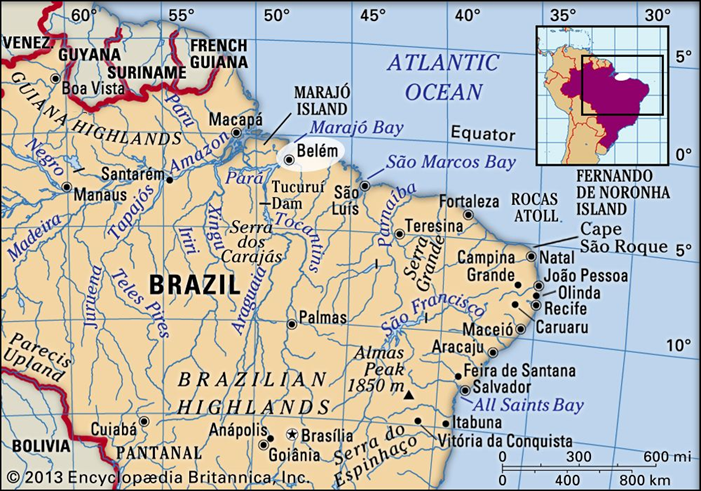
India announced a plan to develop a national platform for climate and nature finance.
The announcement was made at a ministerial event during COP30 in Belém, Brazil.
India joined 13 other developing countries and regions in declaring similar initiatives.
The initiative includes regional bodies such as the African Islands States Climate Commission (AISCC).
The initiative also includes participating countries such as Cambodia and Colombia.
About the Platform
The platform is supported by the Green Climate Fund (GCF) Readiness and Preparatory Support Programme.
The Readiness Programme, defined as a capacity-building initiative, supports country-driven efforts to strengthen institutional systems for climate action.
The programme enhances institutional capacities required for large-scale climate planning.
It strengthens governance mechanisms for long-term climate action.
It improves planning processes for transformational climate agendas.
The platform aims to create strategic and country-driven mechanisms that convert climate priorities into investment-ready programmes.
It replaces the fragmented, project-based approach previously used for climate finance mobilization.
It provides a structured platform for better coordination among stakeholders.
These stakeholders include public and private actors, both domestic and international.
About the Green Climate Fund (GCF)
The Green Climate Fund is the world’s largest climate fund.
GCF was established during COP 16 in Cancun in 2010 under the UNFCCC.
GCF serves the Paris Agreement in line with Article 9, which mandates financial support for developing countries.
The fund’s mandate is to help developing countries raise and achieve their Nationally Determined Contributions (NDCs).
NDCs are defined as national climate action commitments aimed at low-emission and climate-resilient pathways.
The GCF Board governs the fund.
The fund remains accountable to and guided by the COP under the UNFCCC framework.
The headquarters of the GCF is located in Songdo, Incheon City, Republic of Korea.
Food Waste Breakthrough (FWB) launched at COP30 in Belem |
The Food Waste Breakthrough (FWB) was launched at COP30 in Belém.
FWB was announced as a 2030 Climate Solution.
FWB operates under the Marrakech Partnership for Global Climate Action, which is a UN-led platform to accelerate climate solutions.
The initiative unites governments, cities, and civil society in a coordinated global effort.
It focuses on tackling the issue of food waste, which contributes to both global hunger and climate change.
The initiative aims to halve global food waste by 2030.
It also targets achieving up to 7% reduction in methane emissions by 2030.
The Global Environment Facility (GEF) has committed US$3 million to support the initiative.
Brazil is one of the country champions participating in FWB.
Japan is also a participating country champion.
The United Kingdom is another country champion supporting the initiative.
Multiple global cities are part of the FWB coalition.
Several private-sector partners are also involved in advancing the initiative.
Integrated Forum on Climate Change and Trade (IFCCT) |
The Integrated Forum on Climate Change and Trade (IFCCT) was launched at COP30.
The forum aims to create a permanent and politically supported space for global discussions.
The purpose of this space is to address the increasingly contentious intersection between trade policies and climate action.
This intersection refers to situations where trade rules influence climate decisions, or climate policies affect trade flows.
The IFCCT will be institutionally independent of the World Trade Organization (WTO).
It will also be independent of the United Nations Framework Convention on Climate Change (UNFCCC).
The forum will be co-chaired by Brazil as a key developing country leader.
It will also be co-chaired by a developed country partner, ensuring balanced representation.
The IFCCT is open to all parties to the UNFCCC, allowing broad global participation.
The forum will not negotiate binding outcomes, ensuring its role remains consultative.
It will not interpret existing agreements, avoiding legal complications.
It will not adjudicate disputes, distinguishing it from judicial bodies.
It will not evaluate specific national measures, maintaining a neutral and non-intrusive mandate.
Systematic Observation Impact Bond (SOIB) |
The Systematic Observation Impact Bond (SOIB) is the world’s first impact bond focused on weather and climate data.
The SOIB has recently opened for contributions from global stakeholders.
The bond will be formally announced as part of the COP30 (UNFCCC) Action Agenda.
The SOIB functions as a finance instrument designed to strengthen climate resilience.
It also aims to improve early warning systems worldwide.
The bond seeks an initial capitalization of USD 200 million by the end of 2026.
The initiative is pioneered by the Systematic Observations Financing Facility (SOFF).
SOFF is a United Nations fund dedicated to improving weather and climate observations.
SOFF was created jointly by the UN Environment Programme (UNEP).
It was also created by the World Meteorological Organization (WMO).
Additionally, it was created by the UN Development Programme (UNDP).
The SOIB is significant because it will help 30 Least Developed Countries (LDCs) meet global observation standards.
It will also support Small Island Developing States (SIDS) in improving observational capacity.
The bond aims to help these countries achieve compliance with the Global Basic Observing Network (GBON) standards.
GBON standards define internationally agreed requirements for essential weather and climate observations.
Emergence of ‘White Collar’ Terrorism |
A recent terror incident in Delhi brought to light a new trend called white-collar terrorism.
White-collar terrorism involves educated professionals such as doctors and engineers participating in terrorism.
These professionals weaponize their professional legitimacy to conceal extremist activities.
They also leverage their academic networks to support violent objectives.
They use their access to financial and institutional resources for facilitating terror operations.
This trend contrasts with the traditional belief that terror groups radicalize unemployed and vulnerable individuals.
Reasons for the Emergence of White Collar Terrorism
The Relative Deprivation Theory explains extremism as arising from perceived injustice rather than poverty.
The theory suggests that individuals may turn extremist when they feel their group must assert itself.
The Social Identity Theory states that grievances can push individuals to seek an overarching identity.
This theory explains how a professional identity can be replaced by an extremist “higher-purpose” identity.
The rise of digital technology has also enabled white-collar terrorism.
Digital insulated platforms, defined as secured digital environments, require advanced technical skills.
These platforms make professionals a strategic asset for modern terror networks.
Other Emerging Forms of Terrorism
Lone Wolf Terrorism involves individuals who operate alone to commit violent acts.
The Christchurch attack in New Zealand is an example of lone-wolf terrorism.
Suicide bombings use terrorists as human bombs who are certain to die.
The Pulwama attack is an example of a suicide bombing.
Sleeper cells consist of operatives who live quietly within society until activated.
Over Ground Workers (OGWs) are individuals who provide logistical support to militants.
India’s Counter-Terrorism Strategy
India counters terrorism through strong investigation and intelligence agencies.
These agencies include the National Investigation Agency (NIA), National Security Guard (NSG) and Intelligence Bureau (IB).
India uses a strong legal framework through the Unlawful Activities (Prevention) Act (UAPA), 1967.
India prevents terror financing through the Terror Funding and Fake Currency Cell (TFFC) under the NIA.
India also uses the Combating Financing of Terrorism (CFT) Cell under the Ministry of Home Affairs.
India has adopted retaliatory responses such as the 2016 surgical strike.
India also conducted Operation Sindoor in 2025 as part of its counter-terror operations.
NASA launched ESCAPADE Mission |
NASA launched the ESCAPADE mission aboard a Blue Origin New Glenn rocket.
The mission’s full name is Escape and Plasma Acceleration and Dynamics Explorers.
The objective of ESCAPADE is to study how the solar wind interacts with Mars’ magnetic environment.
The mission also aims to understand how this interaction causes atmospheric escape on Mars.
Mars’ magnetosphere consists of remnants of magnetic fields from an ancient planetary core.
It also includes a weaker magnetic field present in Mars’ upper atmosphere.
The spacecraft was launched into a “loiter” orbit around Earth.
This loiter orbit specifically loops around Earth’s Lagrange Point 2 (L2).
Lagrange points are positions where the gravitational pull from two large bodies equals the centripetal force needed for a smaller object to remain in stable motion.
These points allow spacecraft to reduce fuel consumption while maintaining position.
Anegada Passage |

Fighter jets and guided-missile destroyers recently transited the Anegada Passage.
This movement took place as part of the United States’ Operation Southern Spear.
Operation Southern Spear is aimed at countering narco-terrorism in the Caribbean.
The Anegada Passage is a major maritime channel in the West Indies.
The passage connects the Atlantic Ocean with the Caribbean Sea.
The Anegada Passage is 65 km wide, making it a significant navigation route.
It separates the British Virgin Islands located to its west.
It also separates the Leeward Islands located to its southeast.
The Anegada Passage is one of the two major passages through which subsurface water enters the Caribbean Sea.
The Windward Passage is the other major route for subsurface water inflow.
Senkaku Islands |

A formation of China Coast Guard ships recently passed through the waters surrounding the Japan-administered Senkaku Islands.
Japan and China have a long-running territorial dispute over these islands.
The Senkaku Islands are located in the East China Sea.
The islands form part of Japan’s Okinawa Prefecture.
The Senkaku Islands are known as Diaoyu in Chinese.
Ambaji Marble and the Geographical Indication (GI) Tag |
Ambaji Marble has recently received the Geographical Indication (GI) Tag.
Ambaji Marble is produced in the Banaskantha district of Gujarat.
The marble is known for its milky white colour.
It is also valued for its natural beauty.
It is recognized for its high durability.
The marble is widely used in temples across India.
It is also used in memorials.
It is further used in large and grand buildings.
About the GI Tag
A Geographical Indication (GI) Tag is a certification given to products originating from a specific region.
A GI Tag is granted to products that possess inherent qualities linked to that region.
It is also granted based on the reputation associated with the product’s origin.
It is granted when a product has unique characteristics tied to its geographical location.
In India, GI Tags are granted under the Geographical Indications of Goods (Registration and Protection) Act, 1999.
The validity of a GI Tag is 10 years.
The nodal authority for GI management is the Department for Promotion of Industry and Internal Trade (DPIIT).
DPIIT functions under the Ministry of Commerce and Industry.
Raulane Festival of Himachal Pradesh |
Raulane Festival is celebrated in Himachal Pradesh to preserve ancient faith and tradition.
It is an ancient 5,000-year-old festival of the Kinnaur district in Himachal Pradesh.
The festival honours mystical celestial fairies known as Saunis.
A key ritual involves two men acting as a symbolic groom and bride, called Raula and Raulane.
Raula and Raulane are fully covered in traditional Kinnauri woollens.
This act symbolizes a link to the divine.
During the festival, the pair walks in a procession to the Nagin Narayan Temple.
At the temple, they perform a slow devotional dance as part of the ritual.
Read Daily Quotes
Stay updated with the latest news by joining our Telegram channel – The PRESS Pad , and follow us on Instagram and X.
Comments