Daily Current Affairs - 23rd & 24th January 2026
- Kaushal
- Jan 24
- 22 min read
Updated: Jan 28
Comprehensive UPSC Current Affairs Summary | EU GSP Suspension for India, Board of Peace, UNEP State of Finance for Nature 2026, Circular Economy of E-Waste & Lithium Batteries, NITI Aayog Green Transition Roadmaps, NCTAD Global Investment Trends Monitor, Techno-Legal AI Governance White Paper, Delhi Declaration 2026 & ECINET Platform, Military Quantum Mission Framework, Digital Climate Atlas, Pumped Hydro Storage Push, ACC-PLI Challenges, PM SVANidhi Credit Card, Granth Kutir Inauguration, ASC ARJUN Humanoid Robot and more.
If you missed Monthly Current Affairs Pointers (CAP) | Nov - Dec 2025, read it hereTable of Content
SECURITY / DEFENCE
SCIENCE & TECHNOLOGY
ENVIRONMENT & GEOGRAPHY
Generalised Scheme of Preferences (GSP)
The European Union has extended the suspension of preferential trade benefits for India under its Generalised Scheme of Preferences (GSP).
About EU's GSP
First introduced in 1971, establishing a policy of unilateral trade preferences for-
Poverty reduction: By expanding exports from vulnerable countries
Promoting Sustainable development and good governance
Consists of 3 tiers:
General GSP: Duty reductions on 66% of tariff lines for eligible developing countries.
GSP+: Zero duties on 66% of tariff lines for countries that implement core human rights, labor, and sustainability conventions.
Everything but Arms (EBA): Full duty-free access for Least Developed Countries (LDCs) on all imports except weapons.
India’s Absence from the US-Proposed Board of Peace
India was absent when the US President announced the formation of a “Board of Peace”, indicating selective global participation.
The announcement ceremony was attended by representatives from 19 countries, showing limited but diverse international involvement.
Participating countries included Argentina, Canada, Egypt, Saudi Arabia, and Turkey, representing multiple regions.
About the Board of Peace
The Board of Peace is a proposed international organisation, meaning it has not yet been institutionalised.
It is designed as a transitional governing body, which refers to a temporary authority managing post-conflict situations.
The Board is aimed at managing post-conflict transitions, particularly in Gaza, which is currently conflict-affected.
Its primary objective is to oversee post-conflict governance, which involves administration and civil authority.
The Board will also coordinate security, meaning maintaining order and preventing renewed violence.
Another objective is to manage reconstruction, which includes rebuilding infrastructure and institutions.
It seeks to mobilise international resources, referring to funds, expertise, and humanitarian assistance.
The Board aims to ensure accountability, meaning transparency and responsibility in post-conflict actions.
The US President will chair the Board, placing the United States in a leadership role.
The Board will have an executive board of select global leaders, indicating limited decision-making authority.
Membership will be invitation-based, meaning countries are not automatically eligible.
The structure includes fixed-term members, whose tenure is time-bound.
It also includes paid permanent members, suggesting institutionalised financial roles.
Transition: Relevance to India and Global Governance
India’s absence from the Board of Peace highlights broader concerns regarding representation in global decision-making bodies.
These concerns directly connect to India’s long-standing demand for UN Security Council (UNSC) reforms.
UNSC Reforms Model Proposed by the G4
The G4 nations include India, Brazil, Germany, and Japan, which are major global economies and contributors.
The G4 have proposed a model for early action, meaning immediate steps rather than prolonged negotiations.
The proposal focuses on restructuring the United Nations Security Council (UNSC).
The G4 nations support each other’s bids for permanent UNSC seats, forming a reform alliance.
About the United Nations Security Council (UNSC)
The UNSC was established under the UN Charter, which is the founding treaty of the United Nations.
It is one of the six principal organs of the United Nations.
The UNSC holds primary responsibility for maintaining international peace and security.
The Council currently has 15 members, each holding one vote. There are 5 Permanent Members (P5): USA, UK, France, China, and Russia.
The P5 possess veto power, meaning they can block any substantive resolution.
There are 10 Non-Permanent Members, elected by the UN General Assembly.
Non-Permanent Members serve a 2-year term.
These members are not eligible for immediate re-election.
Key Reforms Proposed by the G4
The G4 propose expanding the UNSC to 25 or 26 seats, increasing inclusivity.
The proposal includes 6 new Permanent Members, raising the total to 11 permanent seats.
It also proposes 14 or 15 Non-Permanent Members, increasing rotational representation.
Regional distribution of the new Permanent seats is based on geographic balance.
Africa will receive 2 new Permanent seats, addressing historical under-representation.
Asia-Pacific will receive 2 new Permanent seats, reflecting population and economic weight.
Latin America and the Caribbean will receive 1 new Permanent seat.
Western Europe and Other States will receive 1 new Permanent seat.
Need for UNSC Reforms
The current UNSC reflects an outdated power structure, rooted in the 1945 post-World War II order.
This structure ignores modern geopolitical and economic power shifts.
The interests of the Global South remain insufficiently represented.
Veto power often leads to decision-making deadlock, limiting effective action.
Such deadlocks were evident during conflicts like Ukraine and Gaza.
Repeated inaction has damaged the credibility of the UNSC.
Major nations such as India lack permanent representation, despite global influence.
The UN faces financial dependence on a small group of donors.
The USA is one of the largest contributors, creating budgetary vulnerability.
This dependence risks undue influence over UN operations and priorities.
State of Finance for Nature 2026 Report by UN Environment Programme (UNEP)
The report highlights a global financial imbalance in spending, skewed towards nature-negative finance in comparison to nature-positive finance.
Nature-positive finance are investments in activities promoting environmental conservation. E.g. Nature-based Solutions (NbS)
Nature-negative finance are investments that potentially degrade natural infrastructure. E.g. Environmentally Harmful Subsidies
Key Highlights of the Report
Massive Funding Gap: In 2023, finance for nature-negative activities reached $7.3 trillion (30 times higher), while investment in nature-based solutions (NbS) was just $220 billion.
Public-Private finance gap: 90% of NbS finance is public finance while private finance is concentrated in high-impact sectors like fossil fuels, heavy industry, etc.
Investment Need: To meet the Rio Convention targets (limiting warming to 1.5°C and halting biodiversity loss), annual NbS investment must increase by >2.5 times to $571 billion by 2030.
Key Recommendations: Redirecting capital flows away from nature-negative activities, reforming harmful subsidies, Mandating disclosure of nature-related risks, Expanding blended finance and de-risking investments to mobilise private capital.
About Nature Based Solutions (NbS)
NbS leverage nature and the power of healthy ecosystems to address societal challenges through actions to protect, sustainably manage, and restore natural and modified ecosystems, benefiting people and nature at the same time.
E.g. Protecting and restoring coral reefs, Building greener cities, etc.
Key Initiatives for NbS Global
India
|
WEF announced five new ‘Fourth Industrial Revolution (IR 4.0) Centres’ globally
One of the Centre will be built in in Andhra Pradesh, India as well.
It will be 3rd such centre in India after Mumbai and Telangana.
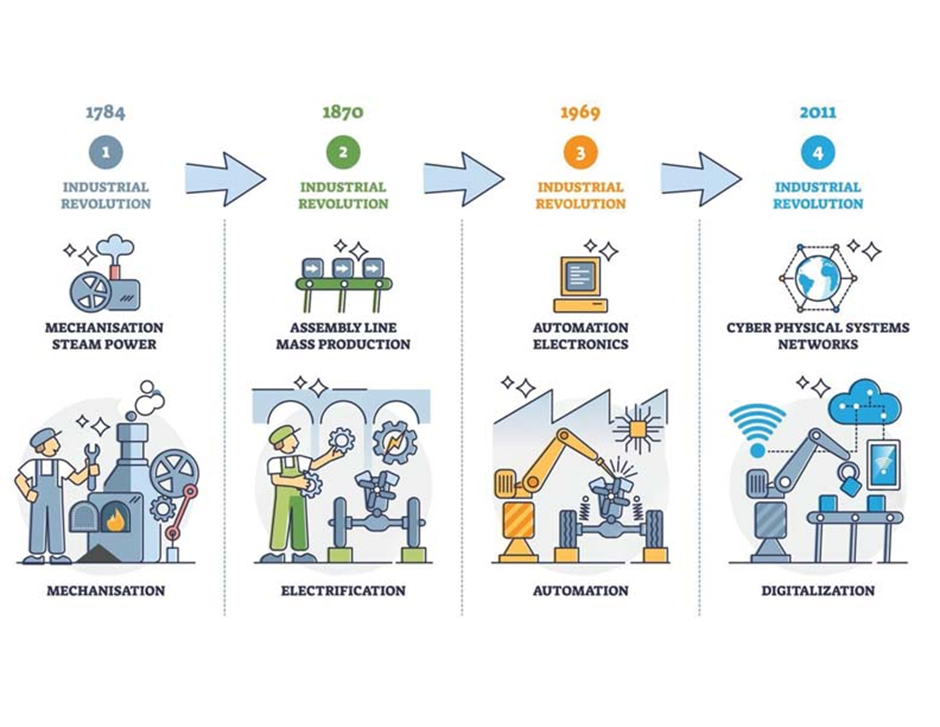
What is the Fourth Industrial Revolution?
The term was coined by Klaus Schwab, founder of the World Economic Forum (WEF) in 2016.
IR 4.0 describes the current era in which digital, physical and biological technologies converge such as AI, robotics, the Internet of Things (IoT), quantum computing, etc.
Unlike earlier revolutions, IR 4.0 is blurring boundaries between physical, digital and biological systems.
Significance of Fourth Industrial Revolution
Economic growth: Enhances productivity and improves supply chain resilience through automation, data analytics and smart manufacturing.
Inclusive development potential: Offers developing countries like India an opportunity to leapfrog legacy technologies and expand digital access.
Environmental sustainability: Supports low-carbon and resource-efficient growth through smart grids, precision agriculture and circular economy practices.
For example, "Lighthouse" factories have demonstrated significant reductions in CO2 emissions and water usage through predictive analytics and IoT.
Human capital centrality: Shifts the focus from physical labour to skills, innovation, and lifelong learning.
Challenges and Risks
|
Report on Circular Economy of E-Waste and Lithium-ion Batteries
The report has been released by NITI Aayog in collaboration with The Energy and Resources Institute (TERI).
Circular economy is a model of production and consumption, which involves sharing, leasing, reusing, repairing, refurbishing and recycling existing materials and products.
Challenges in Circularity of E-Waste
Informal and inefficient collection: Approximately 78% of India's total E-waste is processed by the informal sector, achieving material recovery rates of only 10-20% compared to 95-97% in formal facilities.
Weak monitoring & enforcement: Manipulation of Extended Producer Responsibility (EPR) system. E.g. spurious EPR certificates.
Limited EPR coverage: Only a few metals dominate, Iron (52%), Copper (18%) etc.; critical minerals (such as Lithium and Cobalt) remain neglected.
Low technical capacity: Lack of skills and technologies for efficient, safe, and scalable recycling.
Recommendations
Strengthen Waste Management Rules: Monitoring of recyclers through an expanded of EPR coverage to include high-value metals.
Provide Incentives: Additional incentives proposed for manufacturers of Advanced Chemistry Cells under the Production Linked Incentive (PLI).
Integrate Battery recycling into the Indian Carbon Market, allowing recyclers to monetize Green House Gas (GHG) emission reductions.
Informal Sector Integration: Use the single-window system; establish a separate vertical in National Critical Mineral Mission (NCMM) only on recycling.
Other: Consumer awareness; skilling and re-skilling of workforce, etc.
Status of E-Waste in India
India’s Initiatives
Global Best Practices
|
NITI Aayog Reports on Green Transition in Cement, Aluminium and MSME Sectors
NITI Aayog released sector-specific reports outlining decarbonisation roadmaps for the cement, aluminium, and MSME sectors.
These reports aim to align industrial growth with India’s climate commitments through structured emission reduction pathways.
About Decarbonisation
Decarbonisation refers to the process of reducing or eliminating carbon dioxide (CO₂) emissions from economic activities or industrial sectors.
It focuses on shifting away from fossil fuels towards cleaner energy and low-carbon technologies.
India’s Key Climate Targets
Under Nationally Determined Contributions (NDCs), India aims to reduce emissions intensity of GDP by 45% by 2030 compared to 2005 levels.
Emissions intensity refers to GHG emissions per unit of GDP.
Under the Panchamrita commitment, India targets net zero greenhouse gas (GHG) emissions by 2070.
Net zero means balancing total emissions with equivalent carbon removal or offset mechanisms.
Why Decarbonising These Sectors is Significant
The cement sector contributes about 6% to India’s total GHG emissions.
The aluminium sector contributes about 2.8% to India’s total GHG emissions.
MSMEs rely heavily on fossil fuels for energy and production processes.
MSMEs emitted approximately 135 million tonnes of CO₂ equivalent (MtCO₂e) in 2022.
CO₂e (carbon dioxide equivalent) is a metric used to compare emissions of different greenhouse gases.
Decarbonisation helps mitigate export risks from emerging global trade regulations.
One such regulation is the EU’s Carbon Border Adjustment Mechanism (CBAM).
CBAM imposes a carbon cost on imports from carbon-intensive industries.
Sector-wise Recommended Decarbonisation Roadmaps
Aluminium Sector
The aluminium sector is recommended to transition to Renewable Energy–Round-the-Clock (RE-RTC) power.
RE-RTC ensures continuous power supply from renewable sources using storage and grid balancing.
The roadmap also recommends enhanced grid connectivity for cleaner electricity access.
These measures can enable 10% emission reduction by 2030.
The sector is encouraged to adopt nuclear power for low-carbon baseload electricity.
Nuclear power provides large-scale, non-fossil, continuous energy.
The roadmap proposes Carbon Capture, Utilisation and Storage (CCUS) in captive coal-based plants.
CCUS captures CO₂ emissions and stores or reuses them instead of releasing them into the atmosphere.
Cement Sector
The cement sector is advised to increase Refuse-Derived Fuel (RDF) usage.
RDF is fuel produced from non-recyclable municipal solid waste.
The roadmap promotes greater use of clinker substitutes.
Clinker substitutes reduce emissions by lowering the need for carbon-intensive clinker production.
CCUS deployment is recommended for deep decarbonisation.
These combined measures can lead to 80–85% reduction in GHG emissions by 2070.
MSME Sector
The roadmap proposes a National Programme for Green Transition of MSMEs.
The programme focuses on scaling up Energy Efficiency (EE) across MSMEs.
Energy efficiency refers to using less energy to perform the same industrial activity.
EE measures include retrofitting with energy-efficient equipment.
MSMEs are encouraged to adopt green electricity.
Green electricity options include Green Open Access and PM Suryaghar-like initiatives.
Green Open Access allows consumers to purchase renewable power directly from producers.
MSMEs are advised to shift towards alternative fuels.
Alternative fuels include biomass and natural gas.
These measures can achieve 75–87 MtCO₂e reduction in GHG emissions.
RBI report highlights Demographic Transition in India and its implications for State Finances
The report ‘State Finances: A Study of Budgets of 2025-26’ also provides a comprehensive analysis of fiscal position of State governments.
Key-highlights of report related to demographic transition in India
Inflection Point: With a median age of 28 years, working-age population is at a historical peak.
Inter-State divergences:
Youthful States: States with a high share of young population (e.g., Bihar, Uttar Pradesh) have a wider window of opportunity.
Intermediate States: States like Telangana and Uttrakhand are seeing a narrowing window of opportunity.
Ageing States: States like Kerala and Tamil Nadu have crossed the demographic turning point, where share of working-age population has begun to decline.
Fiscal implications of demographic transition on states:
Shrinking Tax Base: In ageing states, shrinking labour force lowers long-term growth rates, thereby eroding tax base.
Rising Committed Expenditure: Ageing states face upward pressure on committed expenditure (pensions and interest payments).
In 2024-25, ageing states allocated nearly 30% of their social sector spending to pensions.
Fiscal Vulnerability: Ageing states have higher debt-to-GSDP ratios and higher interest payment-to-revenue receipt ratios.
Policy Suggestions
Youthful States: Massive investment in education, skilling, and health is non-negotiable to convert the youth bulge into a productive workforce.
Intermediate States: Pursue a dual strategy of growth-enhancing investments while gradually building social security and healthcare buffers for the future.
Ageing States: Harness "silver economy" by extending working lives, raising retirement ages in alignment with life expectancy, and promoting flexible work arrangements for the elderly.
Other key-highlights of report
|
Global Investment Trends Monitor (GITM)
The United Nations Conference on Trade and Development (UNCTAD) released GITM.
UNCTAD (Founded in 1964, based in Geneva) is the UN's principal organ for trade, investment, and development.
Key Findings of GITM
India:
FDI inflows surged by 73% to $47 billion in 2025.
Reason: due to large investments in services including finance, IT, and R&D as well as manufacturing, supported by policies aimed at integrating India into global supply chains.
Global:
FDI reached $1.6 trillion in 2025 (14% increase).
FDI inflows to China declined for the third consecutive year, falling by 8% to an estimated $107.5 billion.
White Paper on “Strengthening AI Governance Through Techno-Legal Framework”
The White Paper was released by the Office of the Principal Scientific Adviser (OPSA).
The paper proposes a shift from traditional “command-and-control” regulation to a techno-legal model for AI governance.
Command-and-control regulation refers to rigid, prescriptive rules enforced uniformly across all actors.
The techno-legal model integrates technology-based safeguards with legal oversight.
Core Philosophy of the Techno-Legal Framework
The framework promotes governance by design in AI systems.
Governance by design means embedding legal and ethical requirements at the system design stage itself.
The framework supports pro-innovation and flexible regulation.
Pro-innovation regulation balances risk mitigation with continued technological advancement.
The framework follows risk-proportionate controls.
Risk-proportionate regulation means governance intensity varies with the scale and potential harm of AI use.
The framework mandates human oversight at critical decision points.
Human oversight prevents unchecked automated decision-making and potential harm.
The framework adopts lifecycle-based governance.
Lifecycle-based governance applies safeguards from data collection to deployment and real-world use.
Lifecycle-Based AI Governance Framework
1. Data Collection Stage
The data collection stage faces risks of privacy breaches.
The stage also risks inclusion of malicious or deepfake content.
Deepfakes are synthetic media generated using AI to mimic real individuals.
The stage risks intellectual property (IP) violations.
The stage risks sampling bias in datasets.
The framework proposes Data Protection Impact Assessments (DPIA).
DPIA evaluates potential privacy risks before data processing begins.
The framework mandates consent verification.
The framework recommends privacy threat modeling.
2. Data-in-Use Protection Stage
This stage faces risks of unauthorized data access.
The stage risks data poisoning attacks.
Data poisoning involves malicious manipulation of training or input data.
The stage risks exposure of sensitive data to third parties.
The framework proposes Privacy-Enhancing Technologies (PETs).
PETs enable data processing while minimizing exposure of personal information.
The framework includes Differential Privacy.
Differential Privacy adds statistical noise to prevent individual identification.
The framework includes Synthetic Data.
Synthetic data is artificially generated data that preserves patterns without revealing real identities.
The framework includes Confidential Computing.
Confidential computing protects data during processing using secure execution environments.
3. AI Training and Assessment Stage
This stage faces model inversion attacks.
Model inversion attempts to reconstruct sensitive training data from model outputs.
The stage risks memorization of personal data.
The stage suffers from lack of explainability.
Explainability refers to the ability to understand and interpret AI decisions.
The framework proposes red-teaming exercises.
Red-teaming involves simulating adversarial attacks to test system robustness.
The framework mandates stress testing of AI models.
The framework recommends scoring models for privacy, safety, fairness, and explainability.
4. Safe AI Inference Stage
This stage risks AI hallucinations.
Hallucinations occur when AI generates confident but incorrect or fabricated outputs.
The stage faces prompt injection attacks.
Prompt injection manipulates AI inputs to bypass safety restrictions.
The stage risks harmful outputs during real-time interaction.
The framework proposes runtime monitoring.
Runtime monitoring ensures continuous oversight during AI operation.
The framework introduces Responsible AI firewalls.
Responsible AI firewalls filter or block unsafe or non-compliant outputs.
The framework recommends risk-tagging of prompts.
Prompts are classified as Red, Amber, or Green based on risk levels.
5. Trusted AI Agents Stage
Trusted agents face risks of autonomous actions beyond assigned scope.
The stage risks privilege escalation.
Privilege escalation occurs when agents gain unauthorized access or control.
The stage suffers from lack of auditability.
The framework mandates agent identity authentication.
The framework introduces context-based firewalls.
Context-based firewalls restrict actions based on situational permissions.
The framework proposes kill switches.
Kill switches enable immediate shutdown of malfunctioning AI systems.
The framework requires behavior logging for audit trails.
Challenges in Implementing the Techno-Legal Framework
A key challenge is privacy versus performance trade-offs.
Large-scale data erasure can reduce AI model performance.
Performance loss disproportionately affects underrepresented linguistic and cultural groups.
Another challenge is the distinction between AI users and AI subjects.
AI subjects are individuals affected by AI decisions without actively using the system.
In Indian welfare sectors like healthcare and public safety, citizens are often AI subjects.
AI subjects often lack mechanisms to contest automated outcomes.
A challenge exists in cross-border alignment and enforcement.
AI models trained abroad may not embed Indian legal safeguards.
This creates a regulatory gap in accountability.
Another challenge is balancing compliance with system accuracy.
Techno-legal controls can impact AI system performance.
Way Forward
Institutional Mechanisms
The paper recommends a whole-of-government approach to AI governance.
A proposed body is the AI Governance Group (AIGG).
AIGG will coordinate AI policy across ministries and departments.
Another proposed body is the Technology and Policy Expert Committee (TPEC).
TPEC will pool expertise in law, public policy, and AI safety.
Technological Enablers
The framework proposes Machine Unlearning.
Machine Unlearning enables removal of specific data to enforce the right to erasure.
The framework supports Synthetic Data for privacy protection.
The framework recommends Content Provenance mechanisms.
Content provenance uses watermarking and metadata to detect deepfakes.
The framework suggests Digital Public Infrastructure (DPI) integration.
DPI integration includes platforms like Aadhaar and UPI.
DEPA Integration
The framework proposes integration with Data Empowerment and Protection Architecture (DEPA).
DEPA enables consent-based data sharing through standardized digital mechanisms.
DEPA supports trusted execution environments for secure data processing.
Delhi Declaration 2026
Election commission of India’s conference International Conference on Democracy and Election Management 2026 concluded with adoption of Delhi Declaration 2026.
About Delhi Declaration 2026
Global Election Management Bodies (EMBs) adopted 5 key-pillars to safeguarding democratic integrity:
Purity of Electoral Rolls: EMBs should strive to provide Photo Identity Cards to all electors.
Conduct of Elections: EMBs to function as per the mandate laid down in their Constitution or in their respective laws.
Research and Publications: Bring out Encyclopaedia of Democracies of the World.
Use of Technology: India to share its experience of the digital platform ECINET, for co-development of a similar platform for any other EMB.
Training and Capacity Building: India to share its vast experience through training and exchange of its transparent practices.
ECINET
Election Commission of India (ECI) launches ECINET Digital Platform at International Conference on Democracy and Election Management (IICDEM) 2026.
Its beta version was successfully piloted during 2025 Bihar Assembly Elections.
About ECINET Platform
Integrated digital ecosystem of ECI, enabling end-to-end management of electoral processes through a single unified platform.
World’s largest electoral service platform.
Key services offered: Voter registration, electoral roll search, Track Your Application, Know Your Candidate, Connect with Election Officials, e-EPIC download, grievance redressal, etc
Significance: Enhances transparency, efficiency and real-time election monitoring.
CDS released the ‘Military Quantum Mission Policy Framework’
Key Highlights of the Framework
Vision: It aims for jointness and integration among the Tri-Services to achieve technological dominance in future battlefields and prepare for technology-centric warfare.
Civil-Military Fusion: Aligned with National Quantum Mission (NQM) to ensure collaboration between civilian research and military applications through dedicated governing bodies.
Core Domains: Prioritises four critical quantum pillars:
Quantum Communication,
Quantum Computing,
Quantum Sensing & Metrology and
Quantum Materials and Devices.
Applications of Quantum Technology in Defence
Secure Communications: Quantum Key Distribution (QKD) uses the principle of entanglement to create keys that are theoretically unhackable.
Quantum Sensing & Metrology: Quantum Radar and Imaging can detect stealth aircraft and submarines invisible to traditional radar.
Quantum Navigation: Quantum sensors can enable high-accuracy navigation in environments where GPS is jammed.
Intelligence & Logistics: Quantum algorithms can optimize battlefield logistics, analyze vast "SIGINT" (Signals Intelligence) datasets, and power autonomous robotic systems through Quantum AI.
Quantum Materials: Development of materials with adaptive properties (e.g., changing camouflage) or extreme durability for aerospace applications.
Cyber Defence: Transitioning to Post-Quantum Cryptography (PQC) (resisting attacks by quantum computers) to safeguard critical infrastructure against future quantum-enabled cyberattacks.
About Quantum Technology
|
TeraWave
Blue Origin to deploy thousands of satellites for the new ‘TeraWave’ communications network.
About TeraWave Communications Network
A hybrid constellation of 5,408 satellites spanning both low Earth orbit (LEO) and medium Earth orbit (MEO).
It provides symmetrical bandwidth through radio frequency and optical connectivity.
Optical Connectivity transmits data using light pulses through fiber optic cables or free space, rather than electrical signals.
It relies on the modulation of light waves to achieve high-speed, high-bandwidth, and low-latency information transfer.
Target: Services strictly support enterprise, government, and data center clients providing reliable connectivity for critical operations.
Government Launches Digital Climate Atlas, Marking 15 Years of NICRA
The Government of India launched a Digital Climate Atlas to mark 15 years of the NICRA initiative.
The digital platform is titled Atlas of Climate Adaptation in Indian Agriculture (ACASA-India).
ACASA-India is designed to support farmers in planning for climate-related challenges.
About ACASA-India Platform
ACASA-India is a digital decision-support platform for climate adaptation in agriculture.
The platform enables location-specific and data-driven adaptation planning.
Location-specific planning tailors interventions to local agro-climatic conditions.
The platform aims to promote climate-resilient agriculture.
Climate-resilient agriculture focuses on reducing vulnerability to climate variability and extremes.
Institutional Development of ACASA-India
ACASA-India has been developed by the ICAR-led National Agricultural Research and Extension System (NARES).
NARES is a network of agricultural research institutions and extension agencies in India.
The platform was developed in collaboration with the Borlaug Institute for South Asia (BISA).
BISA works on agricultural research for sustainable intensification.
The collaboration also involved CIMMYT.
CIMMYT stands for the International Maize and Wheat Improvement Center.
Policy Relevance of ACASA-India
Insights from ACASA-India will assist government agencies in decision-making.
The platform will help determine future investment requirements for climate risk mitigation.
Climate risk mitigation involves reducing exposure and sensitivity to climate hazards.
ACASA-India will also identify scaling opportunities for climate-resilient practices.
National Innovations in Climate Resilient Agriculture (NICRA)
About NICRA
NICRA stands for National Innovations in Climate Resilient Agriculture.
NICRA was launched by the Indian Council of Agricultural Research (ICAR).
The scheme was launched in 2011.
ICAR is the apex body for agricultural research and education in India.
Objectives of NICRA
One objective of NICRA is to enhance the resilience of Indian agriculture to climate change.
Another objective is to reduce vulnerability of agricultural systems to climate variability.
NICRA aims to validate climate-resilient technologies.
The scheme also aims to demonstrate climate-resilient technologies on farmers’ fields.
Four Components of NICRA Scheme
The first component of NICRA is strategic research.
Strategic research is supported through network, sponsored, and competitive grants.
The second component is technology demonstration and dissemination.
Technology dissemination ensures field-level adoption of proven practices.
The third component is knowledge management.
Knowledge management involves systematic generation and sharing of climate-related agricultural information.
The fourth component is capacity building.
Capacity building strengthens the skills of farmers, scientists, and extension workers.
Climate Resilient Agriculture (CRA)
Definition of CRA
Climate Resilient Agriculture (CRA) refers to adoption of adaptation and mitigation practices in agriculture.
Adaptation practices reduce the impact of climate stress on farming systems.
Mitigation practices reduce greenhouse gas emissions from agriculture.
CRA enhances the ability of agricultural systems to withstand climate shocks.
CRA also improves the capacity to recover quickly from climate-induced disruptions.
Need for Climate Resilient Agriculture
Preventing Yield Loss
Climate change can reduce agricultural yields by 4.5% to 9.0%.
Yield losses can lead to around 1.5% GDP loss per year.
GDP loss reflects the macro-economic impact of declining agricultural productivity.
Protecting Rural Livelihoods
Around 57% of rural households depend on farming for income.
Climate shocks directly threaten rural livelihoods and income security.
Rainfed Area Vulnerability
51% of India’s net sown area is rainfed.
Rainfed agriculture depends solely on monsoon rainfall without assured irrigation.
Rainfed areas produce approximately 40% of India’s total food output.
Rainfed agriculture is highly sensitive to climate variability.
Food Security Concerns
Climate change increases food security risks in India.
India faces rising issues of undernourishment.
Climate stress worsens child malnutrition.
Climate change also aggravates micronutrient deficiencies.
Pumped Hydro Storage
India aims to develop 100 GW of hydro pumped storage by 2047 to stabilise its renewable energy surge.

About Pumped Hydro Storage
What it is: Pumped Hydro Storage is a large-scale electricity storage technology that stores energy in the form of gravitational potential energy of water, using two reservoirs at different elevations.
Mechanism: During periods of excess electricity, water is pumped from a lower reservoir to an upper reservoir.
When demand increases, the stored water is released back through turbines to generate electricity.
Significance: grid stability and peak-load management.
Advanced Chemistry Cell Production Linked Incentive (ACC-PLI) scheme
Lack of critical technologies is threatening the Advanced Chemistry Cell Production Linked Incentive (ACC-PLI) scheme.
About ACC-PLI scheme
The scheme was approved in 2021.
Type: Central Sector Scheme
Purpose: For enhancing India's Manufacturing Capabilities of ACC Battery storage
ACC are the new generation advanced energy storage technologies that can store electric energy (either as electrochemical or as chemical energy ) and convert it back to electric energy as and when required.
Localization: Achieving a domestic value addition of at least 25% and raise it to 60% domestic value addition within 5 Years.
Incentive: The total annual cash subsidy to be disbursed by the Government will be capped at 20GWh per beneficiary firm.
Prime Minister Street Vendor’s Atma Nirbhar Nidhi (PM SVANidhi) Scheme
Prime Minister launched the PM SVANidhi Credit Card for street vendors.
About PM SVANidhi Credit Card
Eligibility Criteria: All street vendors who have successfully repaid their 2nd tranche loan and are eligible for the 3rd tranche under the PM SVANidhi Scheme.
Credit Limit: It will be a RuPay retail (personal) credit card with ₹30,000 limit and revolving credit facilities.
PM SVANidhi Scheme
Launched in 2020, it is a Central Sector Scheme to facilitate street vendors to access affordable working capital loans for resuming their livelihoods activities, after easing of COVID lockdown.
Implementation: joint responsibility of the Ministry of Housing & Urban Affairs (MoHUA) and Department of Financial Services (DFS).
Pradhan Mantri Gram Sadak Yojana (PMGSY)
Government sanctions over 10,000 km of rural roads across six states under PMGSY-IV.
About PMGSY
Ministry: Ministry of Rural Development
Launched in: December 2000
Type: Centrally Sponsored Scheme
Objective: Provide all-weather road connectivity to eligible unconnected rural habitations as a poverty alleviation strategy, including construction/modernisation of bridges along road alignments.
Phases:
Phase I (2000): Universal rural access and village–market–service linkages.
Phase II (2013): Upgradation and consolidation of rural road network.
Phase III (2019): Upgrading 1,25,000 km of roads to improve connectivity to socio-economic institutions. E.g. schools
PMGSY-IV (2024–29): 25,000 unconnected habitations to be connected via 62,500 km of roads.
Beti Bachao Beti Padhao (BBBP)
The Beti Bachao Beti Padhao (BBBP) campaign has completed 11 years (launched in 2015).
About BBBP
Centrally Sponsored Scheme implemented under Sambal vertical of Mission Shakti.
Joint initiative of Ministry of Women and Child Development, Ministry of Health and Family Welfare and Ministry of Education
Later joined by Ministries of Skill Development & Entrepreneurship and Minority Affairs.
Key Objectives
Improve Sex Ratio at Birth (SRB).
Ensure institutional deliveries at 95% or above.
Increase girls’ secondary education enrolment and skilling by 1% annually.
1% increase in 1st Trimester Anti-Natal Care (ANC) Registration per year
Key Achievements:
National SRB increased from 918 (2014-15) to 930 (2023-24)
Percentage of institutional deliveries increased from 61% (2014-15) to 97.3% (2023-24).
Netaji Subhas Chandra Bose (1897–1945)
Government celebrates Parakram Diwas (23 January) to commemorate 129th Birth Anniversary of Netaji Subhas Chandra Bose.
Indian nationalist leader; advocated for complete independence from British rule.
Key Contributions
President of the Indian National Congress in 1938 and 1939 but resigned due to differences.
He wrote for Chittaranjan Das's newspaper, Forward, and started a paper titled Swaraj to promote independence.
He escaped British house arrest in 1941; sought international support from Germany and Japan during World War II.
Led the Indian National Army (INA or Azad Hind Fauj) from 1943.
Under his leadership, the INA fought alongside Japanese forces against the British in the northeast of India and Burma.
He established the Provisional Government of Free India in Imphal, Manipur to mobilize Indians for an anti-British revolt.
Granth Kutir
The President of India inaugurated Granth Kutir at Rashtrapati Bhavan.
About Granth Kutir
It has a rich collection of manuscripts and books in 11 classical languages of India which are Tamil, Sanskrit, Kannada, Telugu, Malayalam, Odia, Marathi, Pali, Prakrit, Assamese, and Bengali.
Aim:To enhance awareness among the citizens regarding the rich cultural and literary heritage of India.
Coverage: it covers a wide range of subjects such as epics, philosophy, linguistics, history, governance, science, and devotional literature as well as Constitution of India in these languages
Support the vision of Gyan Bharatam Mission(GBM) : GBM is an initiative of ministry of culture to preserve, digitise, and disseminate India’s vast manuscript heritage.
ASC ARJUN
Indian Railways has deployed a humanoid robot ASC ARJUN at Visakhapatnam Railway Station in Andhra Pradesh.
About ASC ARJUN
Objective of Robot deployment: To enhance passenger safety, security and service delivery by assisting RPF personnel .
Key Features and Functions:
It is equipped to assist in intrusion detection through Face Recognition System (FRS), AI-based crowd monitoring, and real-time alerts to Railway Protection Force (RPF) control rooms.
It can make automated public announcements in English, Hindi and Telugu, helping guide passengers and improve awareness on safety and security matters.

Comments